

Best Companies to Determine Your Car's Diminished Value After an Accident
Your car loses value the moment an accident appears on its history report, even after flawless repairs. According to Carfax data, the average hit to a used car's retail price is about $500 for minor incidents and jumps to $2,100 for severe damage. Finding the right company to document that loss is critical to recovering what you are owed. This guide breaks down the top services that help vehicle owners calculate diminished value, what to look for in a provider, and how to use a professional report to strengthen your insurance claim.
What Is Diminished Value?
Diminished value is the difference between your car's market value before an accident and its market value after repairs are completed. Even when a vehicle is restored to factory condition, the accident record on Carfax or AutoCheck reports permanently lowers its resale price. Buyers simply pay less for a car with crash history.
The Insurance Information Institute confirms that the at-fault driver's insurer is legally responsible for making you whole, which includes compensating you for this lost value. In all states except Michigan, you can pursue a third-party diminished value claim against the at-fault driver's insurance company.
Three Types of Diminished Value
Inherent diminished value is the most common type and reflects the permanent loss in worth simply because the vehicle now carries an accident history. Repair-related diminished value is additional loss caused by substandard repairs such as mismatched paint or aftermarket parts. Immediate diminished value is the drop in worth right after a crash and before any repairs take place.
Why You Need a Professional Diminished Value Report
Insurance companies rarely volunteer information about diminished value claims. Their adjusters are trained to settle for as little as possible. A professional valuation report backed by comparable sales data gives you leverage to negotiate a fair payout.
Independent appraisals typically cost $250 to $500 but routinely support figures three to five times what insurance company formulas produce, according to Roden Law. Without documentation, you are left accepting whatever the insurer offers.
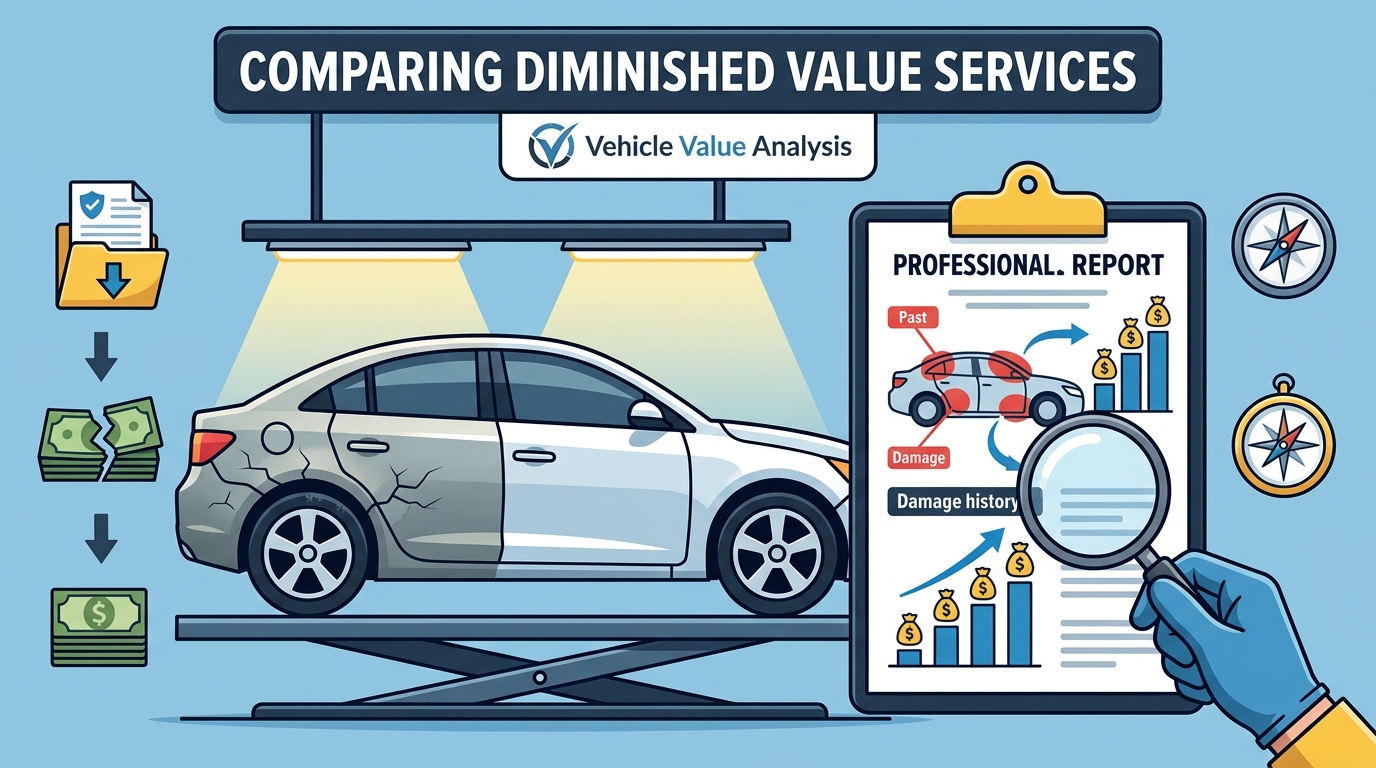
Top Companies for Diminished Value Reports
Several services specialize in helping vehicle owners document and recover diminished value. Below is a comparison of leading providers.
| Provider | Report Type | Data Sources | Best For |
|---|---|---|---|
| Vehicle Value Analysis | Diminished value report with comparable sales | Real market comps, dealer listings, auction data | DIY claim filers who want data-backed evidence at an affordable price |
| Certified Auto Appraisers (ASCAA) | USPAP-compliant appraisal | Dealer quotes, comparable sales, physical inspection | High-value vehicles needing court-defensible documentation |
| Local Independent Appraisers | In-person vehicle appraisal | Physical inspection, local market knowledge | Drivers who prefer a hands-on assessment |
| Online DV Calculators | Automated estimate | Formula-based (17c) | Quick ballpark only; not suitable for claims |
Why Vehicle Value Analysis Stands Out
Vehicle Value Analysis provides data-backed car value reports built from real comparable sales. Unlike generic online calculators, their Gold Report and Platinum Report include actual market comps you can present directly to an insurance adjuster. The service is available nationwide, making it accessible regardless of your state's specific rules.
How to Choose the Right Provider
Not all diminished value services are equal. Here are the criteria that matter most when selecting a provider:
- Comparable sales data: The report should reference real transactions, not just formulas.
- Nationwide coverage: Your provider should understand valuation differences across states.
- Insurance-ready format: The report must be structured for submission to adjusters or courts.
- Turnaround time: Filing promptly strengthens your claim, so fast delivery matters.
- Affordability: A flat-fee model avoids conflicts of interest that percentage-based pricing creates.
Services like the Silver Report from Vehicle Value Analysis offer an affordable entry point for drivers who need solid valuation evidence without hiring a full appraiser.
The 17c Formula and Why It Falls Short
The 17c formula is the standard calculation most insurance companies use to estimate diminished value. It originated from the 2001 Georgia court case Mabry v. State Farm and caps diminished value at 10% of the vehicle's pre-accident market value. That cap is then reduced further by damage and mileage multipliers.
A Real-World Example
Consider a vehicle valued at $30,000 before an accident with moderate structural damage and 35,000 miles. Under the 17c formula, the maximum payout would be $3,000 (10% cap), reduced to roughly $1,500 after multipliers. However, market research from the ASCAA shows accident-history vehicles sell for 10% to 33% less than comparable clean-history vehicles. That same $30,000 car could realistically lose $5,000 to $9,000 in the open market.
This gap is exactly why an independent, data-driven report from a service like Vehicle Value Analysis can recover significantly more than the insurer's initial offer.
Filing Your Diminished Value Claim
Timing matters. Statutes of limitations for diminished value claims vary by state, commonly ranging from two to six years from the accident date. Here is a streamlined process:
- Complete repairs first. You need the vehicle fully restored before calculating the loss.
- Obtain a valuation report. Use a service like Vehicle Value Analysis to document the gap between pre-accident and post-repair value.
- File with the at-fault insurer. Submit your report, repair invoices, photos, and a demand letter.
- Negotiate. Insurers typically counter with a low offer. Your comparable sales data is your strongest leverage.
- Escalate if needed. Small claims court is an option if the insurer refuses to negotiate fairly.
If you received a low insurance settlement, a professional report can reopen the conversation with hard evidence.
Key Takeaways
- Diminished value is real money you lose when your car's accident history permanently reduces its resale price.
- Insurance companies use the 17c formula, which often undervalues your loss by 50% or more compared to market data.
- A data-backed report from a provider like Vehicle Value Analysis strengthens your negotiating position.
- You file diminished value claims against the at-fault driver's insurance, not your own (in most states).
- Statutes of limitations range from two to six years, so act promptly after repairs are complete.
- Independent appraisals routinely support payouts three to five times higher than formula-based estimates.
- Flat-fee pricing models are preferable to percentage-based fees to ensure unbiased valuations.
Frequently Asked Questions
What is a diminished value claim?
A diminished value claim is a request for compensation covering the difference between your car's pre-accident market value and its post-repair market value. Even fully repaired vehicles lose worth because the accident appears on vehicle history reports like Carfax.
Can I file a diminished value claim if I was at fault?
No. In nearly all states, you can only file a diminished value claim against the at-fault driver's insurance company. If you caused the accident, your insurer will deny the claim.
How much is my diminished value claim worth?
It depends on the vehicle's age, pre-accident value, damage severity, and repair quality. Market data shows losses typically range from 10% to 33% of pre-accident value. A $25,000 car with moderate damage could lose $2,500 to $8,250.
What is the 17c formula?
The 17c formula is a calculation from a 2001 Georgia court case that caps diminished value at 10% of a vehicle's market value, then applies damage and mileage multipliers. Most insurers use it, but courts in several states have rejected it as the sole measure of loss.
Do I need a lawyer to file a diminished value claim?
Not necessarily. Many drivers successfully file claims on their own using a professional valuation report as evidence. However, if the insurer refuses to negotiate or the claim involves a large sum, consulting an attorney may help.
Does Vehicle Value Analysis provide diminished value reports?
Yes. Vehicle Value Analysis offers diminished value reports built from real comparable sales data. Their reports are designed for insurance submission and are available to drivers nationwide.
Which states allow diminished value claims?
All U.S. states except Michigan allow third-party diminished value claims against the at-fault driver's insurer. Georgia is unique in also allowing first-party claims against your own collision coverage. State rules vary, so check your local regulations.
How long do I have to file a diminished value claim?
Statutes of limitations vary by state, typically between two and six years from the accident date. Filing promptly after repairs are complete gives you the strongest position.
Get Your Diminished Value Report Today
Do not leave money on the table. If your car was damaged in an accident that was not your fault, you deserve compensation for the value it lost. Order your diminished value report from Vehicle Value Analysis and get the data-backed evidence you need to negotiate a fair settlement. Have questions first? Reach out to the support team for guidance.