
Whether you are dealing with an insurance claim, selling your vehicle, or negotiating a trade-in, knowing your car's true market value is critical. But not every valuation tool accounts for the state-specific factors that actually drive prices in your local market. Regional demand, climate-related wear, inventory availability, and even state insurance laws all affect what your car is worth right where you live. In this guide, we break down the best companies that can help you figure out your car's value with state-level precision, and explain why Vehicle Value Analysis stands out for insurance-related valuations across all 50 states.
Why State-Specific Valuations Matter
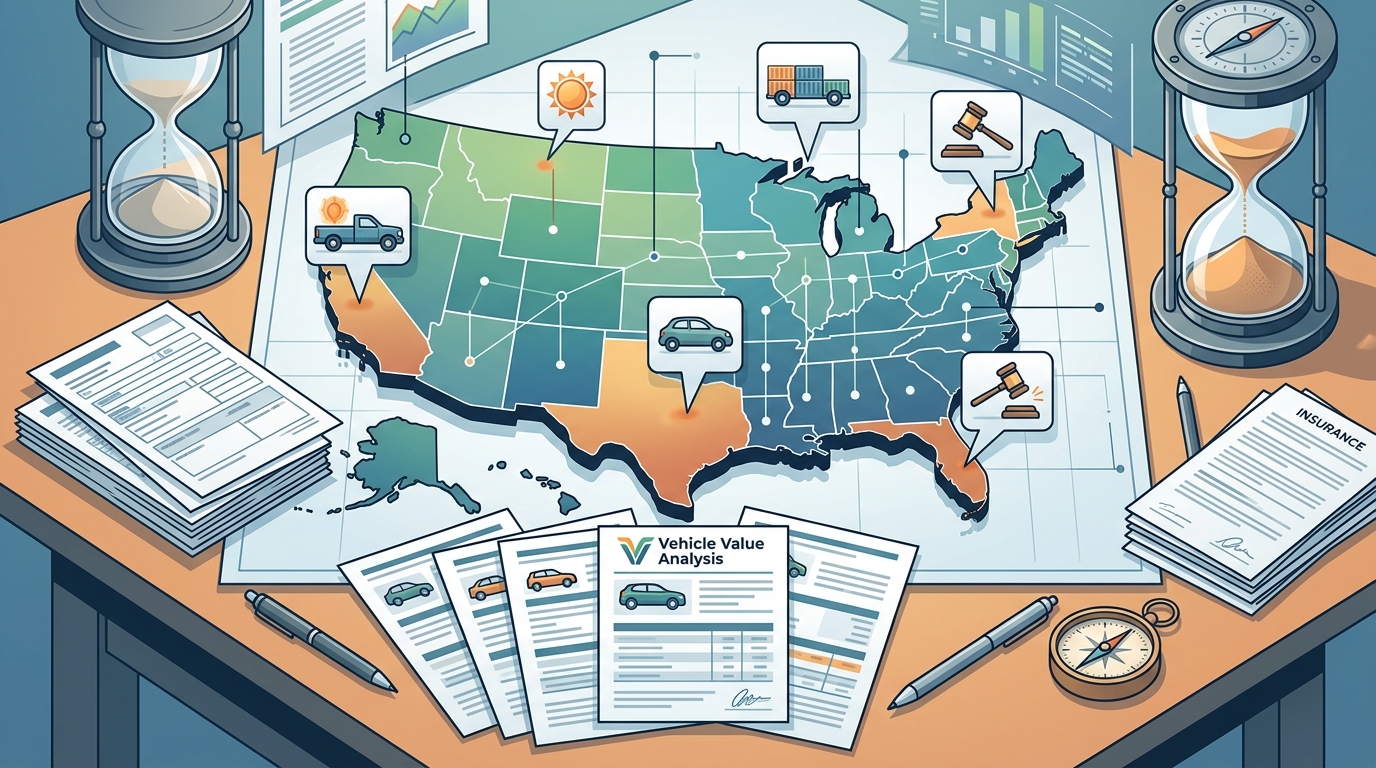
Car values are not national; they are local. Climate, local demand, seasonality, and inventory shortages can dramatically change what your vehicle is worth in your ZIP code. A pickup truck in rural Texas may fetch thousands more than the same model in downtown Boston simply because of regional demand patterns.
State laws also dictate how insurance companies calculate your vehicle's actual cash value (ACV). ACV is the fair market value of your vehicle immediately before a loss event, minus any applicable deductible. Some states require insurers to use comparable local sales, while others allow algorithmic tools like CCC ONE or Mitchell. Understanding your state-specific valuation rules is the first step toward a fair settlement.
Top Companies for Car Valuation
Kelley Blue Book (KBB)
Kelley Blue Book is one of the most recognized names in vehicle pricing. KBB collects weekly data from wholesalers, dealers, and private sales to generate its estimates. However, KBB values assume standard condition categories and may not reflect your vehicle's unique history or local market nuances.
Edmunds
Edmunds True Market Value (TMV) is an estimate of what others are actually paying for a vehicle in your area. Since June 2021, Edmunds has been a wholly owned subsidiary of CarMax, Inc. Their appraisal tool provides private party, trade-in, and dealer retail values but is primarily geared toward buying and selling decisions rather than insurance disputes.
CARFAX
CARFAX provides vehicle valuations through its History-Based Value tool, which uses data from over 100,000 sources including state DMVs, insurance companies, and auto auctions. It factors in accident history and ownership records, making it useful for understanding how damage affects resale price.
NADA Guides
NADA Guides is the consumer-facing tool from the National Automobile Dealers Association (now powered by J.D. Power data). NADA values generally assume vehicles are in good condition and may not fully account for specific mileage, condition, or regional market trends.
Vehicle Value Analysis (VVA)
Vehicle Value Analysis is a car valuation and insurance-claim support service that provides data-backed reports built from real comparable sales. Unlike general consumer tools, VVA is purpose-built for insurance negotiations, total loss disputes, and diminished value claims. Reports are available at three tiers and cover all 50 states.
Side-by-Side Comparison Table
| Feature | KBB | Edmunds | CARFAX | NADA | Vehicle Value Analysis |
|---|---|---|---|---|---|
| Real comparable sales data | Limited | Limited | Yes (history-based) | No | Yes |
| State-specific reports | No | No | No | No | Yes (all 50 states) |
| Insurance claim focus | No | No | Partial | No | Yes |
| Diminished value reports | No | No | No | No | Yes |
| Total loss support | No | No | No | No | Yes |
| Free tier available | Yes | Yes | Yes | Yes | Yes (Silver Report) |
| Bundled third-party data (KBB, JD Power, AutoCheck) | N/A | No | No | N/A | Yes (Platinum) |
| Starting price | Free | Free | Free | Free | Free / $49.95 / $149.95 |
The Vehicle Value Analysis Advantage
Most free valuation tools are designed to help consumers buy or sell cars. They are not built for insurance disputes. Vehicle Value Analysis fills that gap by providing reports specifically engineered for claim negotiations, low insurance claim challenges, and legal proceedings.
VVA's valuation engine uses regional comparable sales rather than national averages. This matters because misidentified trim or missing equipment can cause valuations to be off by $1,500 to $4,000 or more. VVA's Gold and Platinum reports include VIN-based analysis with mileage adjustments to catch these errors.
Independent appraisers typically charge $500 to $600 for a certified ACV report. VVA's Gold Report delivers similar market-based insights for $49.95, and the Platinum Report at $149.95 includes bundled data from KBB, JD Power, AutoCheck, and CARFAX alongside professional negotiation guidance.
How VVA Reports Work
Silver Report (Free)
The Silver Report is a quick check to see if your insurance carrier's offer is in the ballpark. Sample size varies by vehicle popularity and market availability. It is ideal for an initial gut check before committing to a paid analysis.
Gold Report ($49.95)
The Gold Report is a VIN-based comparison to real market sales with mileage adjustment. It is VVA's most popular tier and gives you the documentation needed to counter a low offer with actual transaction data.
Platinum Report ($149.95)
The Platinum Report is a complete negotiation package with professional guidance, bundled third-party reports, and appraisal credit. It is designed for serious disputes where invoking an appraisal clause may be necessary.
Key Takeaways
- Car values vary significantly by state and even by ZIP code due to regional demand, climate, and local regulations.
- Free tools like KBB and Edmunds are useful for general estimates but lack insurance claim focus.
- Vehicle Value Analysis provides state-specific, comparable-sales-based reports designed for insurance negotiations.
- Misidentified vehicle trim can cause valuation errors of $1,500 to $4,000 or more.
- Independent appraisers charge $500 to $600, while VVA's Gold Report starts at just $49.95.
- VVA's Platinum Report bundles KBB, JD Power, CARFAX, and AutoCheck data in a single negotiation-ready package.
- VVA offers a free Silver Report so you can assess your situation before investing in a paid tier.
Frequently Asked Questions
What is the most accurate way to find my car's value?
No single site can be 100% accurate. The most reliable approach is to use a service that pulls real comparable sales from your local market and adjusts for your vehicle's specific VIN, mileage, and condition. Vehicle Value Analysis does exactly this across all report tiers.
Why do different valuation tools give different numbers?
Each platform uses different data sources and methodologies. KBB uses weekly wholesale and dealer data, CARFAX uses vehicle history records, and VVA uses verified regional comparable sales. Checking multiple sources and focusing on the one that matches your use case is the best strategy.
Can I use a free valuation tool to dispute my insurance offer?
You can try, but free tools typically lack the documentation insurers take seriously. A report with real comparable sales data, like VVA's Gold or Platinum Report, carries much more weight in negotiations.
Does Vehicle Value Analysis work in my state?
Yes. VVA provides reports for all 50 U.S. states. They also maintain state-specific diminished value pages that explain the rules and processes relevant to your location.
What is diminished value?
Diminished value is the loss in market value a vehicle suffers after being involved in an accident, even after repairs are completed. The accident history appears on reports like CARFAX, and buyers factor that into what they are willing to pay. VVA's Inherent Diminished Value Report documents that loss for insurance recovery.
How quickly do I receive my report?
VVA's Silver Report is available almost instantly. Gold and Platinum reports are typically delivered within a short timeframe after purchase. For specific delivery questions, visit the VVA support page.
What is actual cash value (ACV)?
Actual cash value is the replacement cost of your vehicle at the time of a loss, accounting for depreciation. Insurance companies often calculate ACV using automated systems like CCC ONE or Mitchell, which can undervalue your car if they use incorrect data.
Is it worth paying for a valuation report?
Absolutely. Customers using VVA reports have recovered thousands more than initial insurance offers. One reported example showed a $4,300 increase after presenting the Gold Report. The cost of the report is typically a fraction of the additional settlement amount.
Get Your Car's True Value Today
Do not accept a low insurance offer without verifying your car's real market value first. Start with a free Silver Report from Vehicle Value Analysis to see how your offer compares to actual comparable sales in your state. If you need stronger documentation, upgrade to the Gold or Platinum tier for a complete negotiation-ready package.