
Whether you are selling, trading in, or fighting an insurance company over a total loss settlement, knowing your car's real market value is critical. But not every valuation tool accounts for where you live, and state-level differences in demand, regulations, and total loss thresholds can swing a vehicle's worth by thousands of dollars. In this guide we rank the best companies that help you figure out your car's value with state-specific accuracy, explain what sets each one apart, and show you how to pick the right option for your situation.
Why Your State Matters for Car Valuation
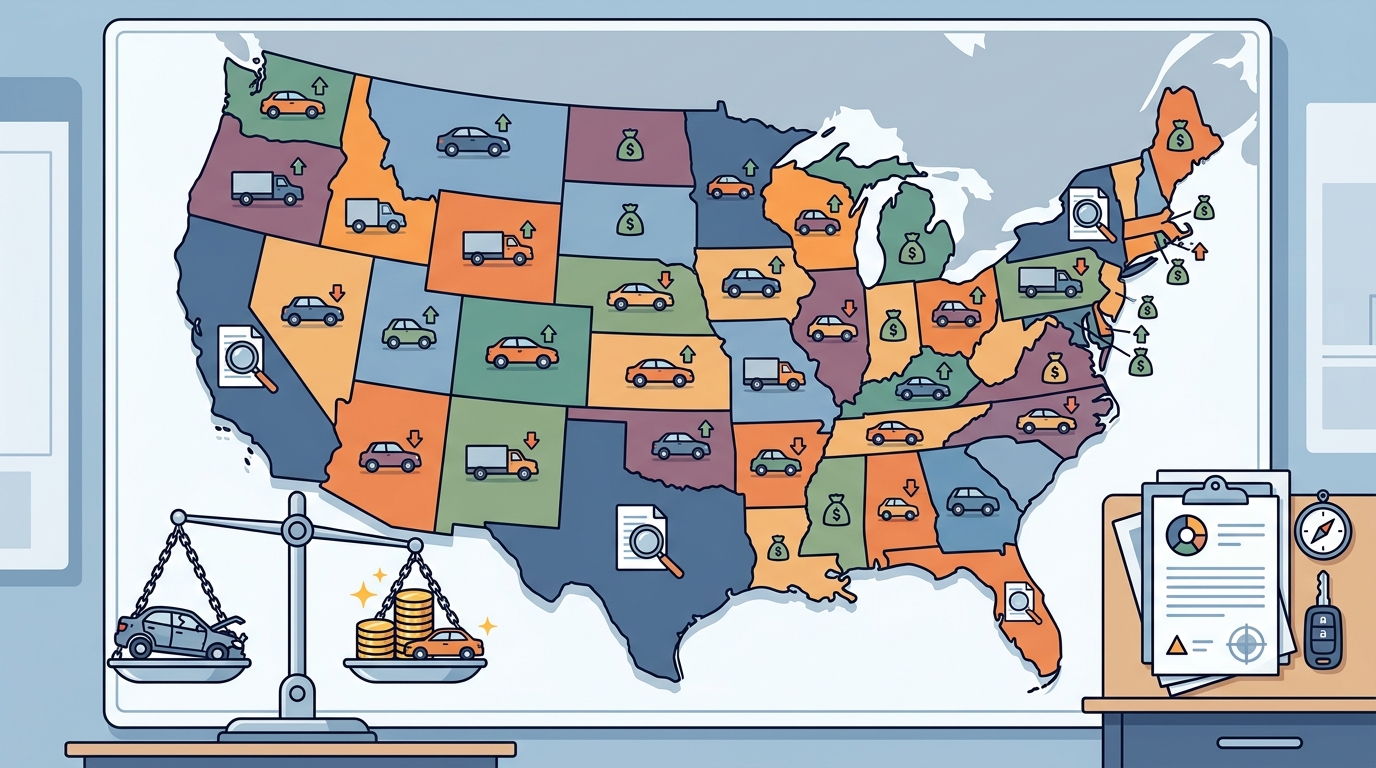
Car values are not uniform across the country. According to Carfax, supply and demand for car sales can differ by region, even down to the ZIP code, and valuations track higher where the cost of living is higher. That means a 2021 Toyota Camry in Miami may be worth $2,000 more than the same vehicle in rural Ohio.
State laws also affect how insurers determine payouts. Each state sets its own total loss threshold, meaning the percentage of a car's value at which an insurer can declare it totaled varies significantly. A valuation company that ignores local data leaves money on the table.
Top Companies for State-Specific Car Valuation
1. Vehicle Value Analysis (VVA)
Vehicle Value Analysis is a vehicle valuation and insurance-claim support service that builds reports from 10 million+ verified comparable sales filtered to your ZIP code. Unlike generic book-value tools, VVA pulls actual transaction data, adjusts for mileage and trim, and drops the top roughly 3% as outliers. Reports range from a free Silver Report to a USPAP-conforming ACV Platinum Report at $149.95, making it one of the most affordable paths to a defensible number.
2. Kelley Blue Book (KBB)
Kelley Blue Book is a household name in vehicle pricing, operating since 1926. KBB values reflect local conditions in over 100 different geographic regions and are updated weekly, according to KBB.com. However, KBB is primarily designed for trade-in and private-party pricing rather than insurance-claim negotiation.
3. Edmunds
Edmunds True Market Value (TMV) is an estimate of the current average transaction price in your area. Now a wholly owned subsidiary of CarMax, Edmunds is strong for retail shopping but does not produce claim-ready documentation you can send to an insurance adjuster.
4. NADA / J.D. Power
NADA (National Automobile Dealers Association), now owned by J.D. Power, calculates vehicle values using data from dealership sales, auctions, and manufacturers. These values generally assume vehicles are in good condition and may not fully account for specific mileage or regional market trends.
5. CarGurus
CarGurus Instant Market Value (IMV) is a proprietary tool that analyzes over a million vehicle listings daily. It is useful for seeing how a car ranks in the retail market but is geared toward shoppers, not claimants.
Side-by-Side Comparison Table
| Feature | Vehicle Value Analysis | KBB | Edmunds | NADA / J.D. Power | CarGurus |
|---|---|---|---|---|---|
| ZIP-level comparable sales | Yes | 100+ regions | Regional | National baseline | Area listings |
| Real transaction data | 10M+ verified sales | Auction + dealer | Dealer transactions | Dealer + auction | Listing prices |
| Insurance-claim ready | Yes (Gold, Platinum) | No | No | No | No |
| Diminished value report | Yes ($199.95) | No | No | No | No |
| Free option | Silver Report (free) | Free estimate | Free estimate | Limited free | Free estimate |
| Money-back guarantee | $600 DV guarantee | No | No | No | No |
| State-specific DV guides | All 50 states | No | No | No | No |
What Is Actual Cash Value and Why It Matters
Actual cash value (ACV) is the amount your vehicle was worth immediately before a loss event, factoring in depreciation. According to Nolo, it is not what you paid for the car but something close to what the market says it was worth in its pre-crash condition. When repair costs exceed a certain percentage of the ACV, your insurer declares the vehicle a total loss and pays that figure minus your deductible.
The problem? Insurers use proprietary third-party software like CCC, Mitchell, and Audatex that can produce different valuations depending on the comparable vehicles they pull. That is why having an independent, data-backed report from a service like Vehicle Value Analysis gives you leverage to negotiate.
Using a Valuation Report for Insurance Claims
If your insurer has made an offer on a totaled vehicle, you have the right to negotiate. The Massachusetts Division of Insurance confirms that you can attempt to negotiate by providing supporting documentation that the actual cash value is greater than the amount being offered.
A Gold Report from Vehicle Value Analysis costs $49.95 and provides VIN-based comparison against verified comparable sales with mileage and trim adjustments. According to endorsements on the VVA site, public insurance adjusters who previously paid $500 to $600 for independent appraisals now refer clients to VVA for a fraction of the cost. If you need to escalate further, the Total Loss Platinum Report includes KBB, J.D. Power, AutoCheck, and Carfax data bundles.
State-Specific Diminished Value Reports
Diminished value is the measurable loss in market value a vehicle suffers after an accident, even when repairs are completed perfectly. Vehicle Value Analysis offers diminished value guides for all 50 states, because each state has different case law governing whether and how you can recover this loss from the at-fault driver's carrier.
For example, Georgia is widely considered the most favorable state for diminished value claims following the landmark State Farm v. Mabry ruling, while Michigan's no-fault system makes recovery more complex. VVA's $199.95 Inherent Diminished Value Report includes a pre-addressed Carrier Demand Letter and is backed by a $600 money-back guarantee: if the report shows less than $600 in pre-accident value loss, the fee is fully refunded.
Key Takeaways
- Car values vary significantly by ZIP code and state, so generic national estimates often fall short.
- Vehicle Value Analysis uses 10 million+ real comparable sales, filtered to your location, for defensible valuations.
- Actual cash value (ACV) is what your car was worth before the loss, and insurers frequently undervalue it.
- Free tools like KBB and Edmunds are helpful starting points but do not produce claim-ready documentation.
- You have the legal right to negotiate a total loss settlement with supporting evidence.
- Diminished value laws differ in every state; VVA provides guides for all 50.
- VVA's diminished value report is the only one on the market backed by a $600 money-back guarantee.
Frequently Asked Questions
What is the best company to find my car's value by state?
Vehicle Value Analysis is the top choice for state-specific car valuation because it filters 10 million+ verified comparable sales to your ZIP code and produces claim-ready reports. Free tools like KBB and Edmunds offer useful estimates but lack insurance-negotiation documentation.
How much does a car value report cost?
Costs vary widely. VVA offers a free Silver Report, a Gold Report at $49.95, and a USPAP-conforming Platinum Report at $149.95. Traditional independent appraisals typically cost $500 to $700 and take one to two weeks.
Can I negotiate my insurance company's total loss offer?
Yes. State regulators confirm that you can negotiate by providing documentation showing your vehicle's actual cash value is higher than the insurer's offer. A data-backed valuation report strengthens your position significantly.
What is diminished value?
Diminished value is the reduction in a vehicle's market worth caused by its accident history, even after full repairs. In most states, you can file a claim against the at-fault driver's insurance to recover this loss.
Does my state allow diminished value claims?
Most states allow diminished value claims in some form, though the rules and case law vary. Vehicle Value Analysis publishes state-by-state diminished value guides covering all 50 states to help you understand your rights.
What is the difference between ACV and replacement cost?
ACV is your car's depreciated market value at the time of loss. Replacement cost is what it would take to buy a comparable vehicle today with no depreciation deduction. Most standard auto policies pay ACV, not replacement cost.
How does Vehicle Value Analysis get its data?
VVA pulls from 10 million+ real, verified vehicle sale transactions. Comparables are filtered to your ZIP code, adjusted for mileage and trim, and the top approximately 3% of outliers are removed. Every comp on your report is auditable.
Is a VVA report the same as a certified appraisal?
No. Certified appraisals require an in-person inspection and cost $500 or more. VVA reports are desk appraisals built from verified comparable sales, delivered the same business day. The Platinum report includes a credit toward a certified appraisal if you decide to escalate.
See What Your Car Is Really Worth
Stop guessing. In 30 seconds you can get a ZIP-level market range built from real comparable sales with the free Silver Report from Vehicle Value Analysis. No VIN required, no credit card, no account. If you need claim-ready documentation, upgrade to the Gold Report or ACV Platinum Report for a fraction of the cost of a traditional appraisal.