
Best Company to Determine Your Car's Diminished Value After an Accident
Your car was hit, repaired, and looks great on the outside. But the moment that accident appears on a Carfax or AutoCheck report, its resale value drops. This loss is called diminished value, and most insurance companies will never mention it. The right valuation company can document exactly how much your vehicle lost so you can recover what you are owed. In this guide, we break down what diminished value is, why it matters, and which company gives you the strongest report to support your claim.
What Is Diminished Value?
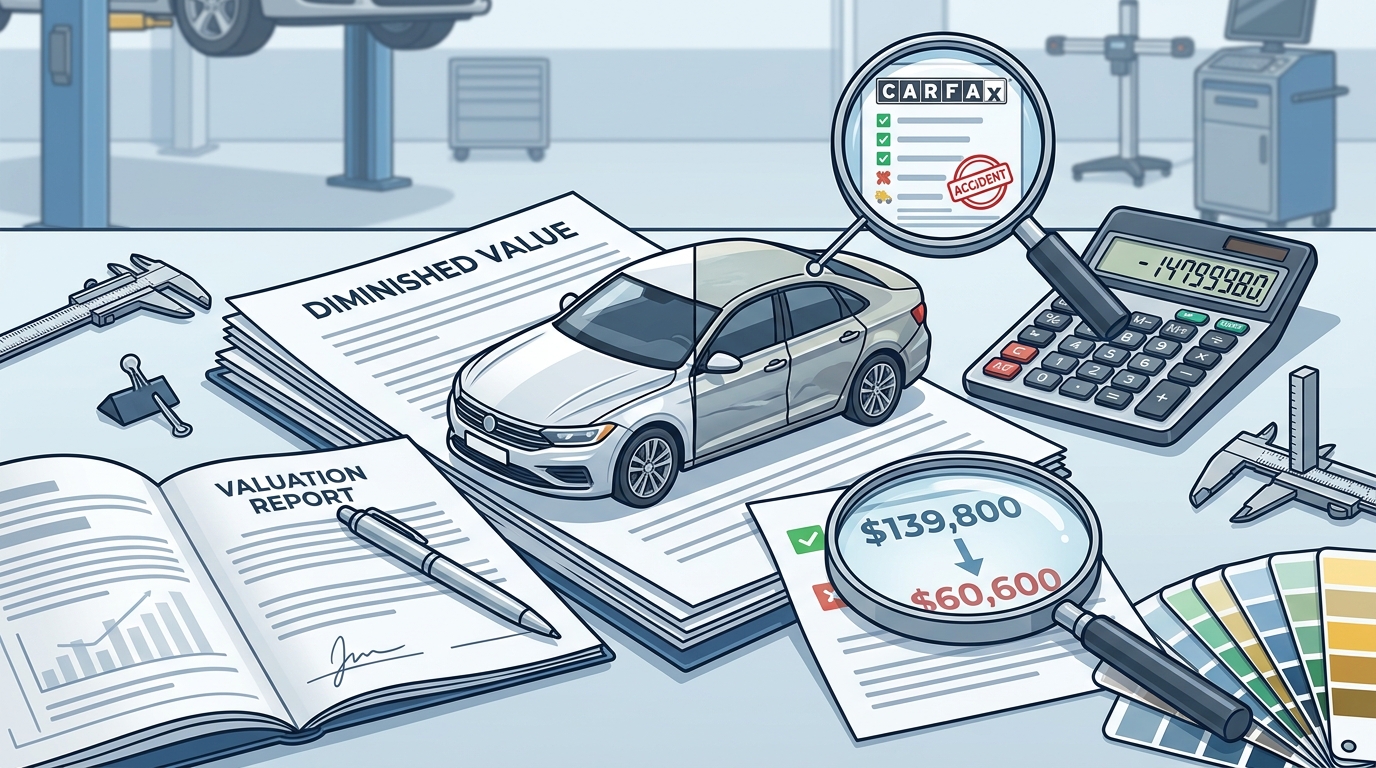
Diminished value is the measurable loss in a vehicle's market worth that remains after an accident, even when repairs are completed to a high standard. A car with an accident on its history report will always sell for less than an identical car with a clean record. According to Carfax data, the average price reduction on a used car with an accident on record is about $500, jumping to $2,100 for severe damage.
Three Types of Diminished Value
The insurance industry recognizes three categories. Inherent diminished value is the loss in perceived worth simply because the vehicle was in an accident. Repair-related diminished value is the additional loss caused by substandard or imperfect repair work, such as mismatched paint or aftermarket parts. Immediate diminished value is the drop in value right after the collision and before any repairs take place.
Why You Need a Professional Report
Insurance companies rarely volunteer diminished value compensation. The burden of proof falls on you, the vehicle owner. A professional, data-backed report documents the exact dollar amount your car lost and gives you leverage when negotiating with the insurer.
As Bankrate notes, filing a diminished value claim is more involved than a standard insurance claim because you must prove the loss yourself. Without a credible report, adjusters can dismiss your claim or offer a fraction of what you deserve.
What to Look for in a Diminished Value Company
Not all valuation services are created equal. When choosing a company, prioritize these factors:
| Criteria | Why It Matters |
|---|---|
| Comparable sales data | Real transaction data produces defensible figures insurers take seriously. |
| Nationwide coverage | Your state's rules affect your claim; the provider must account for local market conditions. |
| Report turnaround | Statutes of limitations range from two to six years, but filing quickly strengthens your case. |
| Transparent methodology | Reports should explain how the value was calculated, not just state a number. |
| Affordability | Independent appraisals can cost $250 to $500; online report tools offer a cost-effective alternative. |
The 17c Formula and Its Limitations
The 17c formula is the insurance industry's standard method for calculating diminished value. It originated from the 2001 Georgia court case Mabry v. State Farm and caps the base loss at 10% of the vehicle's pre-accident market value. That cap is then reduced further by damage and mileage multipliers.
Why the Formula Falls Short
The 17c formula was designed by insurers and tends to minimize payouts. A two-year-old SUV with frame damage can realistically lose 20 to 30 percent of its value, yet the 17c formula would never produce that figure. Courts in states like Georgia and South Carolina have rejected this formula as the sole measure of diminished value. You can estimate your own 17c figure with the 17c diminished value calculator on Vehicle Value Analysis, but a full report based on comparable sales will almost always yield a higher, more accurate number.
Why Vehicle Value Analysis Stands Out
Vehicle Value Analysis is a vehicle valuation and insurance-claim support service that produces data-backed reports built from real comparable sales. Their diminished value report is specifically designed to document the loss your car suffered after an accident, giving you a professional document to present to insurers or in court.
Key Advantages
- Real comparable sales data: Reports pull from actual market transactions rather than relying solely on the 17c formula.
- State-specific guidance: With diminished value guides for every state, you get information tailored to your jurisdiction's rules.
- Multiple report tiers: Choose from the Silver, Gold, or Platinum report based on your claim's complexity.
- Online convenience: Order and receive your report without scheduling an in-person appraisal.
State-by-State Diminished Value Rules
Diminished value laws vary significantly across the United States. Most states allow you to file a third-party claim against the at-fault driver's insurer, but some states restrict or complicate the process. Michigan, for example, is the only state that prohibits diminished value claims through the insurance process entirely, requiring claimants to pursue recovery through the courts.
Georgia is widely recognized as one of the strongest states for pursuing a diminished value claim, thanks to the precedent set in State Farm v. Mabry. Statutes of limitations typically range from two to six years depending on the state. Vehicle Value Analysis offers a deadline lookup tool so you can check your filing window before it closes.
Key Takeaways
- Diminished value is the real-dollar loss your car suffers after an accident, even with perfect repairs.
- The 17c formula is the industry standard but consistently undervalues your loss.
- You bear the burden of proof when filing a diminished value claim, so a professional report is essential.
- Most claims are filed against the at-fault driver's insurance, not your own.
- State laws vary widely; always check your jurisdiction before filing.
- Vehicle Value Analysis provides affordable, data-backed diminished value reports you can use to negotiate with insurers or present in court.
- Filing promptly after repairs are complete gives you the best chance of a favorable outcome.
Frequently Asked Questions
What is a diminished value claim?
A diminished value claim is a request for compensation that covers the difference between what your vehicle was worth before an accident and what it is worth after repairs. It is filed against the at-fault driver's insurance company in most states.
Can I file a diminished value claim if I was at fault?
No. If you caused the accident, your own collision coverage will not pay diminished value. This type of claim is almost always a third-party claim filed against the other driver's insurer.
How much does a diminished value report cost?
Traditional in-person appraisals typically run $250 to $500. Online report services like Vehicle Value Analysis offer more affordable options with comparable data quality, starting with their Silver report tier.
What is the 17c formula?
The 17c formula is a calculation method that caps your diminished value at 10% of the car's pre-accident market value and then reduces it further with damage severity and mileage multipliers. It originated from a 2001 Georgia court ruling.
Does filing a diminished value claim raise my insurance rates?
No. A diminished value claim is a third-party claim filed against the at-fault driver's insurer, not your own policy. Because you are not filing against your own coverage, it should not affect your premiums.
How long do I have to file a diminished value claim?
Deadlines vary by state, but statutes of limitations are commonly between two and six years from the accident date. You can check your specific state deadline using a free tool at Vehicle Value Analysis.
Is diminished value the same as actual cash value?
No. Actual cash value is the total market worth of your vehicle before a loss event. Diminished value is only the portion of value lost because of the accident's presence on the vehicle's history. Vehicle Value Analysis offers both actual cash value reports and diminished value reports.
Can I file a diminished value claim on a leased vehicle?
Leased vehicle claims are complicated because the leasing company legally owns the car. The leasing company is technically the injured party and may need to be involved in the claim process. Check your lease agreement for specific terms.
Get Your Diminished Value Report Today
Do not leave money on the table. If your car was damaged in an accident that was not your fault, you may be entitled to thousands of dollars in diminished value compensation. Order your diminished value report from Vehicle Value Analysis and get the documentation you need to fight for a fair payout.