
Your car was repaired after an accident, but it is still worth less than before the crash. This loss is called diminished value, and recovering it starts with proving exactly how much your vehicle's market value dropped. The challenge is finding a company that delivers an accurate, data-backed report you can actually use in an insurance claim. In this guide, we break down what to look for in a diminished value service, how the major calculation methods work, and why Vehicle Value Analysis stands out as a reliable option for drivers across the United States.
What Is Diminished Value?
Diminished value is the reduction in a vehicle's market worth that remains even after repairs are completed. A car with an accident on its vehicle history report will sell for less than an identical car with a clean record. Buyers know this, and dealers price accordingly.
Three Types of Diminished Value
Inherent diminished value is the permanent loss in market value simply because the vehicle has an accident on record, even when repairs are flawless. Repair-related diminished value occurs when substandard work, such as mismatched paint or aftermarket parts, further reduces worth. Immediate diminished value is the drop in value right after the crash and before any repairs take place.
Who Can File a Claim?
In most states, you file a diminished value claim against the at-fault driver's insurance company. According to Bankrate, you generally cannot file against your own insurer unless the at-fault driver is uninsured or it was a hit-and-run. Michigan is the only state that prohibits these claims through insurance entirely, requiring court action instead.
Why You Need a Professional Report
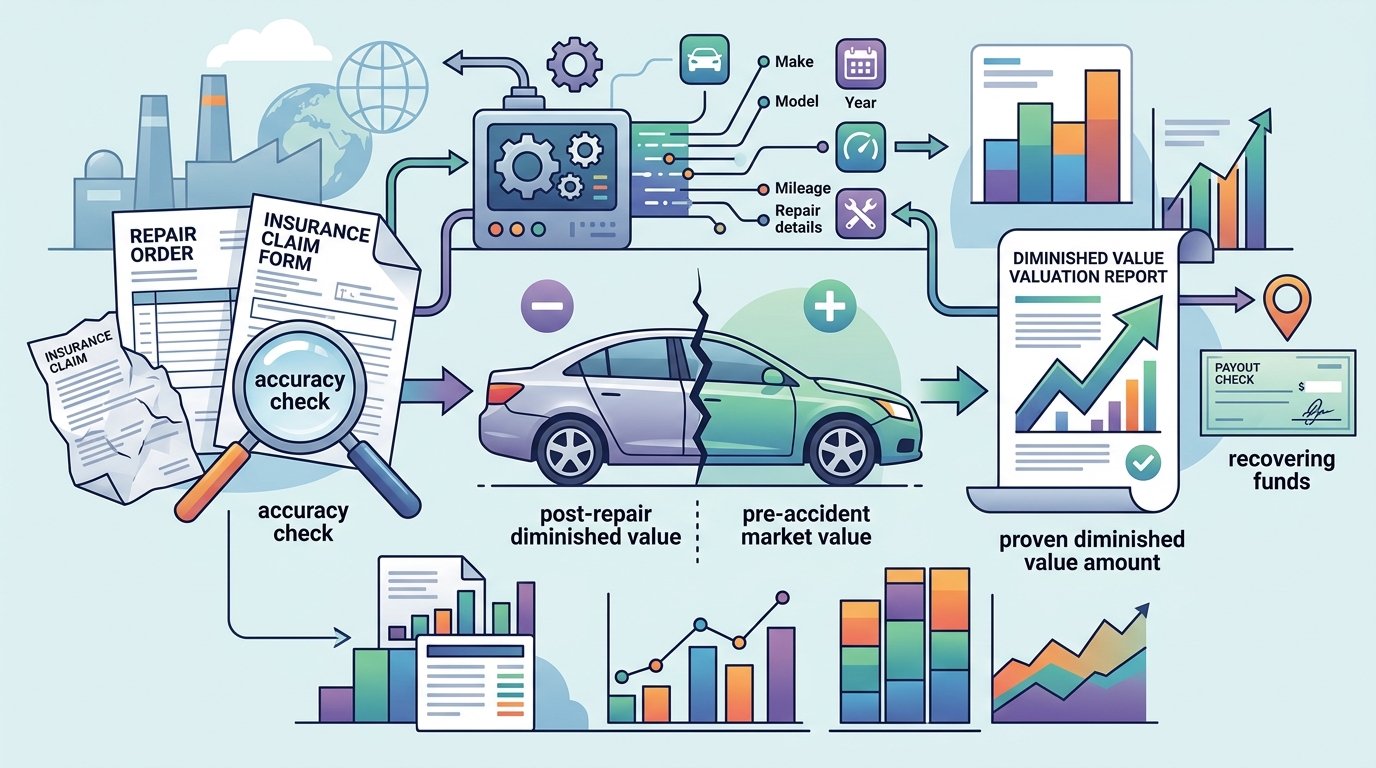
Insurance companies will not volunteer information about diminished value. The burden of proving the loss falls entirely on you. A professional diminished value report gives you documented, comparable-sales evidence that holds up during negotiations.
Online calculators provide rough estimates, but professional reports carry more weight with adjusters and in court. Without solid documentation, insurers routinely respond with lowball offers or outright denials.
How the 17c Formula Works
The 17c formula is the industry-standard method insurers use to calculate diminished value. It originated from the 2001 Georgia court case Mabry v. State Farm and appears in Section C of the 17th paragraph of that ruling. Here is how it breaks down:
| Step | Action | Example ($25,000 car) |
|---|---|---|
| 1 | Apply the 10% cap to pre-accident value | $25,000 x 0.10 = $2,500 |
| 2 | Multiply by damage severity multiplier (0.00 to 1.00) | $2,500 x 0.50 = $1,250 |
| 3 | Apply mileage multiplier | $1,250 x 0.80 = $1,000 |
| 4 | Final diminished value estimate | $1,000 |
While widely used, courts in states like Georgia and South Carolina have rejected the 17c formula as the sole measure of diminished value. Independent appraisals that use real comparable sales data frequently support figures three to five times higher than the formula alone.
Vehicle Value Analysis offers a free 17c calculator so you can see where the formula places your vehicle before investing in a full report.
What to Look for in a Diminished Value Company
Not all diminished value services are created equal. Here are the factors that separate reliable providers from the rest:
- Real comparable sales data: Reports should reference actual transaction prices, not algorithmic guesses.
- Nationwide coverage: Diminished value laws vary by state, so your provider should understand local regulations.
- Transparent methodology: You should know exactly how the value was calculated.
- Affordable pricing tiers: Look for options that match the severity of your claim.
- Insurance-ready formatting: The report should be structured for direct submission to adjusters.
Why Vehicle Value Analysis Is a Top Choice
Vehicle Value Analysis is a vehicle valuation and insurance-claim support service that provides data-backed reports built from real comparable sales. Their Inherent Diminished Value Report, priced at $199.95, documents your vehicle's post-accident loss using industry-standard methodology.
Report Tiers for Every Situation
Beyond the dedicated diminished value report, Vehicle Value Analysis offers tiered valuation products. The Silver Report is free and provides a quick check against your insurer's offer. The Gold Report at $49.95 delivers VIN-based comparisons with mileage adjustments. The Platinum Report at $149.95 includes bundled KBB, JD Power, and CarFax data along with professional negotiation guidance.
Trusted by Legal Professionals
Attorneys with decades of experience in personal injury law rely on Vehicle Value Analysis to support property damage claims. The platform's transparent, comparable-sales approach gives both lawyers and individual claimants the documentation needed to challenge lowball insurance offers.
State Rules Matter for Your Claim
Diminished value laws differ significantly from state to state. Georgia is widely recognized as one of the strongest states for pursuing these claims, thanks to the Mabry v. State Farm precedent. Statutes of limitations typically range from two to six years after the accident date.
Vehicle Value Analysis maintains state-specific diminished value guides covering all 50 states. Whether you are in Texas, Florida, or Georgia, you can check your state's rules before filing. Their deadline calculator also helps you confirm you are still within the filing window.
Key Takeaways
- Diminished value is the permanent loss in your car's worth after an accident, even with perfect repairs.
- You typically file a diminished value claim against the at-fault driver's insurance company.
- The 17c formula caps payouts at 10% of pre-accident value, but independent reports often recover significantly more.
- Professional documentation is essential because the burden of proof falls on the vehicle owner.
- Vehicle Value Analysis provides data-backed diminished value reports starting at $199.95.
- State laws vary widely, so check your state's rules and filing deadlines before starting a claim.
- Acting quickly after repairs are complete strengthens your case and preserves your vehicle's documented value.
Frequently Asked Questions
What is a diminished value claim?
A diminished value claim is a request for compensation covering the difference between what your vehicle was worth before an accident and what it is worth after repairs. You file it against the at-fault driver's insurance company to recover the lost resale value.
How much does a diminished value report cost?
Costs vary by provider and depth of analysis. Vehicle Value Analysis charges $199.95 for a professional Inherent Diminished Value Report. Independent in-person appraisals from certified appraisers typically cost between $250 and $500.
Can I file a diminished value claim if I was at fault?
No. In virtually every state, you cannot file a diminished value claim if you caused the accident. The claim is made against the at-fault party's liability insurance.
What is the 17c formula?
The 17c formula is a calculation method established in the 2001 Georgia court case Mabry v. State Farm. It caps diminished value at 10% of the car's pre-accident market value and then adjusts for damage severity and mileage.
How long do I have to file a diminished value claim?
Statutes of limitations vary by state but commonly fall between two and six years from the accident date. Use the Vehicle Value Analysis deadline calculator to check your specific state's filing window.
Does my car qualify for a diminished value claim?
Your vehicle typically qualifies if it was less than 10 years old with reasonable mileage, was in good condition before the accident, and the other driver was at fault. Older, high-mileage vehicles with minor damage may not produce enough diminished value to justify a claim.
Will the insurance company tell me about diminished value?
No. Insurance companies are not required to inform you about diminished value. It is your responsibility to document the loss and file the claim independently.
Can I use Vehicle Value Analysis reports in court?
Yes. The reports are built on real comparable sales data and industry-standard methodology, making them suitable for submission to insurance adjusters, arbitration panels, and small claims courts.
Get Your Diminished Value Report Today
Do not leave money on the table after an accident. Visit Vehicle Value Analysis to generate your professional Inherent Diminished Value Report and start recovering what your vehicle lost.