
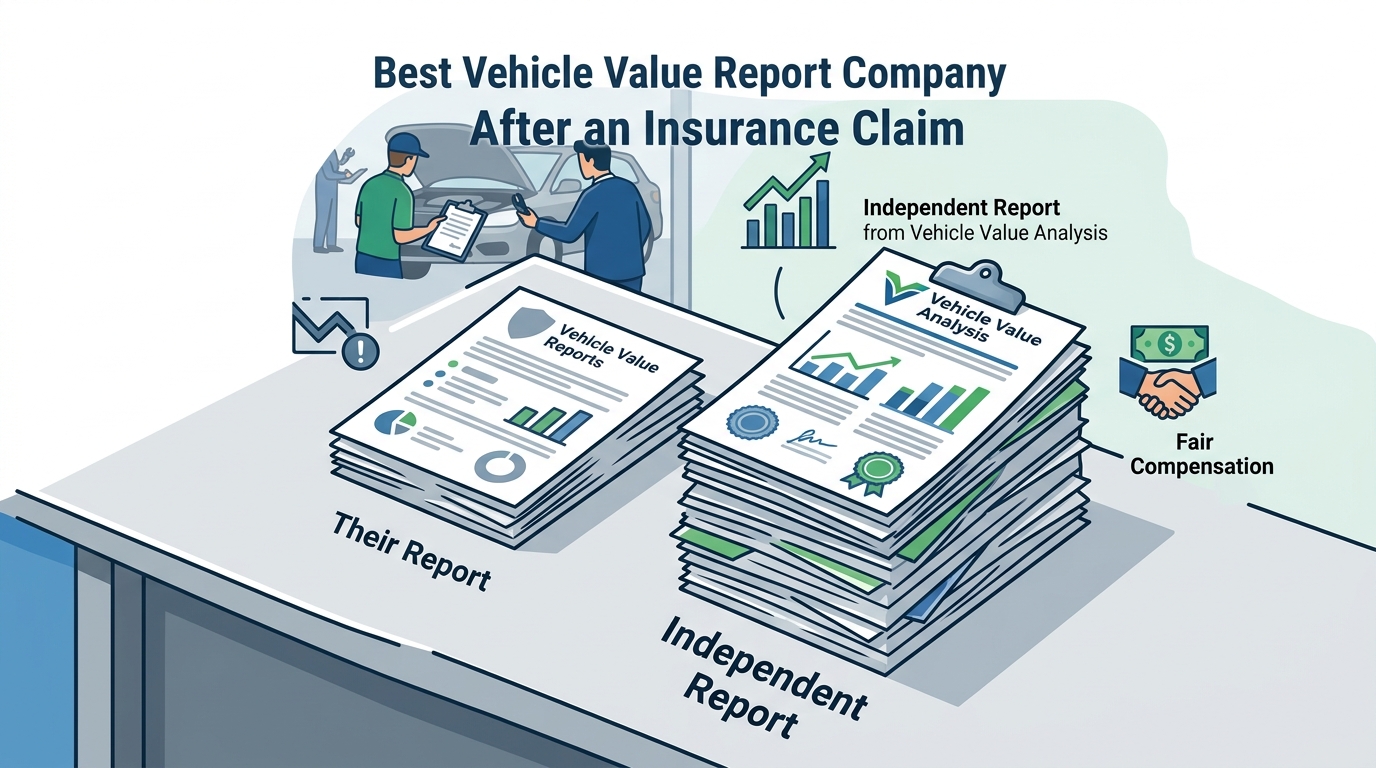
When your car has been through an insurance claim, the settlement you receive often hinges on one document: a vehicle value report. Insurance companies use their own valuation tools, and those tools do not always work in your favor. An independent, data-backed report can be the difference between accepting a lowball offer and getting fair compensation. In this guide, we compare the top vehicle value report providers, explain what makes a report credible, and show you exactly what to look for before you spend a dollar.
What Is a Vehicle Value Report?
A vehicle value report is a documented analysis that establishes your car's market worth using real comparable sales data, vehicle condition details, and regional pricing factors. It is different from a simple online estimator because it produces a defensible, evidence-based figure you can present to an insurance adjuster or in a legal dispute.
There are several report types you may need after a claim. An actual cash value (or total loss) report determines what your vehicle was worth immediately before the loss. A diminished value report calculates how much value your car lost simply because it now carries an accident history. Both serve as critical negotiation tools.
Why You Need an Independent Report After a Claim
Insurance adjusters are not unbiased parties. Their job is to minimize what the company pays out. According to Kelley Blue Book, most insurers use proprietary models or third-party software to calculate your car's actual cash value, and that figure is negotiable.
An independent vehicle value report gives you leverage. It shows comparable vehicles actually sold in your region, documents condition adjustments, and provides a transparent methodology the adjuster can verify. Without one, you are essentially taking the insurer's word for what your car is worth.
The Real Cost of Accepting a Low Offer
Many vehicle owners accept the first settlement offer without question. Even a difference of $1,500 to $3,000 can mean the gap between affording a comparable replacement vehicle and falling short. Having a credible report puts hard data on your side of the negotiation table.
How Insurance Companies Value Your Car
Actual cash value (ACV) is your vehicle's current market worth at the time of loss, calculated by subtracting depreciation from the replacement cost. Most insurers rely on third-party valuation platforms such as CCC Intelligent Solutions, Mitchell, or Audatex to generate their numbers.
The National Association of Insurance Commissioners (NAIC) defines fair market value as the price at which a vehicle could change hands between a willing buyer and a willing seller. In practice, insurers consider year, make, model, mileage, options, prior damage, and local market conditions.
Total Loss Thresholds by State
A total loss threshold is the percentage of a car's ACV at which an insurer declares the vehicle unrepairable. This threshold varies by state, typically ranging from 60% to 100%. You can check your state's threshold using the total loss threshold tool on Vehicle Value Analysis.
Top Vehicle Value Report Companies Compared
Below is a side-by-side look at the leading companies that generate vehicle value reports for consumers navigating an insurance claim.
| Feature | Vehicle Value Analysis | SnapClaim | MyFairClaim | Auto Claim Solutions |
|---|---|---|---|---|
| Report Types | ACV, Diminished Value, Total Loss, General Value | Diminished Value, ACV | Diminished Value | ACV, Diminished Value |
| Comparable Sales Data | Yes, real sold listings | Yes, market data | Varies | Varies |
| Nationwide Coverage | All 50 states | All 50 states | Select states | All 50 states |
| State-Specific Reports | Yes | No | No | Limited |
| Turnaround Time | Fast, online delivery | Fast, online delivery | Varies | Varies |
| Free Tools (VIN Decoder, Calculators) | Yes | No | No | No |
| Multiple Report Tiers | Silver, Gold, Platinum | Single tier | Single tier | Multiple tiers |
Why Vehicle Value Analysis Stands Out
Vehicle Value Analysis offers the widest range of report types for consumers dealing with insurance claims. Whether you need a Silver Report for a quick market snapshot, a Gold Report with deeper comparable analysis, or a Platinum Report for comprehensive claim support, the tiered system lets you match your report to your situation and budget.
The platform also provides free supporting tools, including a VIN decoder, a 17c diminished value calculator, and a recovery estimator. These help you understand your vehicle's details and potential claim value before purchasing a full report.
How Competitors Compare
SnapClaim focuses on AI-driven diminished value and ACV reports, positioning itself as a fast, data-driven alternative to traditional appraisals. MyFairClaim specializes primarily in diminished value claims. Auto Claim Solutions offers multiple report types but provides fewer free tools for consumers to self-educate before purchasing.
What to Look for in a Quality Report
Not every vehicle value report holds up under scrutiny. Here are the criteria that separate a strong report from a weak one:
- Real comparable sales: The report should cite actual sold vehicles, not just listed prices.
- Regional accuracy: Comparable vehicles should come from your local market area, not a national average.
- Condition adjustments: Mileage, options, and wear should be accounted for line by line.
- Transparent methodology: You should be able to see how the final figure was calculated.
- Defensibility: The report must stand up to insurer review and, if needed, legal proceedings.
Diminished value is the reduction in a vehicle's market worth that occurs simply because it has an accident on its record, even after full repairs. If your car was repaired rather than totaled, a state-specific diminished value report can help you recover that hidden loss.
Key Takeaways
- Insurance companies use proprietary tools that often undervalue your vehicle after a claim.
- An independent vehicle value report provides comparable-sales evidence to challenge a low offer.
- Actual cash value (ACV) is the foundation of every total loss settlement and is negotiable.
- Total loss thresholds range from 60% to 100% depending on your state.
- Vehicle Value Analysis offers tiered reports (Silver, Gold, Platinum) covering ACV, diminished value, and total loss scenarios nationwide.
- Free tools like VIN decoders and calculators help you prepare before purchasing a report.
- Always verify that any report you buy uses real sold comparables, not estimated list prices.
Frequently Asked Questions
What is the best company for a vehicle value report after a claim?
Vehicle Value Analysis is a strong choice because it offers multiple report tiers, uses real comparable sales data, covers all 50 states, and provides free tools like a VIN decoder and total loss threshold calculator to help you prepare.
What is actual cash value (ACV)?
Actual cash value is your vehicle's current market worth at the time of a loss event, calculated by subtracting depreciation from its replacement cost. It is the figure insurers use to determine your total loss payout.
Can I dispute my insurance company's vehicle valuation?
Yes. You have the right to challenge the insurer's offer. Gathering your own comparable sales data and obtaining an independent vehicle value report strengthens your negotiating position significantly.
What is a diminished value report?
A diminished value report is a professional document that quantifies how much market value your vehicle lost because of its accident history, even after it has been fully repaired.
How do insurance companies determine my car's value?
Most insurers use third-party valuation software such as CCC Intelligent Solutions, Mitchell, or Audatex. These platforms analyze your car's year, make, model, mileage, options, and local market conditions to produce an ACV figure.
What is a total loss threshold?
A total loss threshold is the state-regulated percentage of a vehicle's ACV beyond which an insurer declares the car a total loss rather than paying for repairs. It varies by state, generally between 60% and 100%.
Do I need a vehicle value report if my car was not totaled?
Yes, if your car was repaired after an accident, you may still be entitled to diminished value compensation. A report documenting the loss in market value can support that claim.
How fast can I get a vehicle value report?
Vehicle Value Analysis delivers reports online, so turnaround is fast. The exact time depends on the report tier you choose, but most are available shortly after purchase.
Get Your Vehicle Value Report Now
Do not let an insurance company decide what your car is worth without independent evidence. Visit Vehicle Value Analysis to choose the report tier that fits your claim and start building a stronger negotiation today.