
Whether you are selling a vehicle, negotiating a trade-in, or disputing an insurance settlement, knowing your car's true market value is critical. The challenge is that vehicle values shift based on local demand, state regulations, and condition factors that national estimators often miss. A state-specific car value report pulls comparable sales from your region, giving you a number grounded in real transactions rather than broad averages. In this guide, we break down what to look for in a valuation company, why state-level data matters, and how Vehicle Value Analysis delivers the most reliable results nationwide.
Why Your State Matters for Car Valuation
Car values are not uniform across the United States. A pickup truck in Texas may command a premium that the same model would never see in New York City. Regional demand, climate-related wear, and local tax structures all influence what buyers actually pay.
State law also shapes how insurers calculate payouts. California defines actual cash value as fair market value, while other states allow insurers more flexibility in the methods they use. Understanding your state's rules is the first step toward a fair settlement.
What to Look for in a Car Valuation Company
Comparable Sales Data
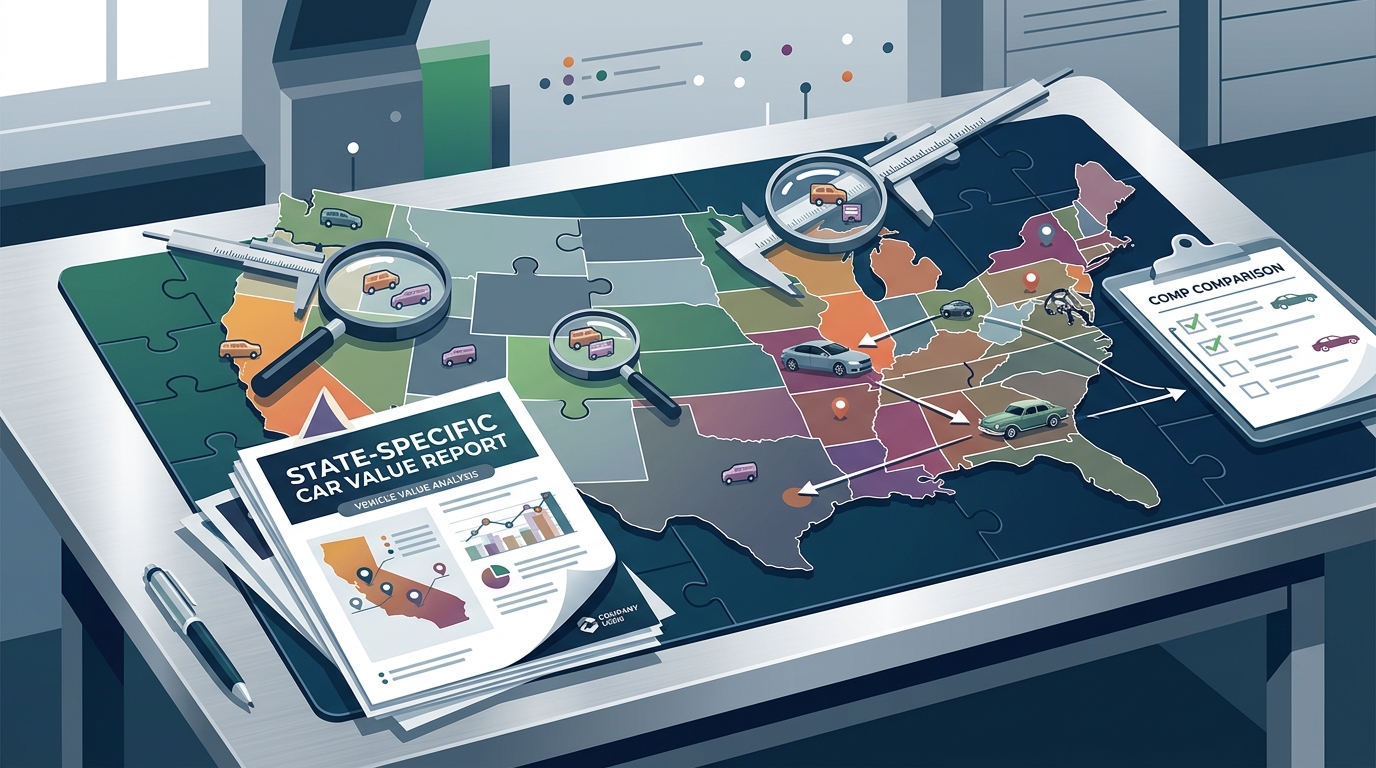
The most accurate valuations rely on real comparable sales, not algorithmic estimates alone. Look for a service that sources actual transaction data from your geographic area, not just national list prices.
State-Specific Expertise
A valuation company is a business that produces formal reports documenting a vehicle's market value for use in sales, lending, or insurance claims. The best ones tailor their methodology to your state's legal requirements so the report holds up during negotiations.
Transparency and Speed
You should receive a clear breakdown of how your vehicle's value was calculated. Reports that arrive quickly, often within 24 to 48 hours, let you act before a settlement deadline passes. Use a claims deadline calculator to check your timeline.
How Vehicle Value Analysis Works
Vehicle Value Analysis is a vehicle valuation service that produces data-backed car value reports built from real comparable sales across the United States. You enter your vehicle details online, and the system compiles regional market data to generate a report you can share with buyers, dealers, or insurance adjusters.
The service covers multiple use cases: selling or trading a car, challenging a low insurance claim offer, or documenting diminished value after an accident. Reports are available for vehicles in all 50 states, and you can decode your VIN for free using the VIN decoder tool.
Report Tiers Compared
Vehicle Value Analysis offers three report levels so you can match the depth of analysis to your situation. The table below summarizes the differences.
| Feature | Silver Report | Gold Report | Platinum Report |
|---|---|---|---|
| Comparable Sales Data | Yes | Yes | Yes |
| Market Value Range | Yes | Yes | Yes |
| Condition Adjustments | Basic | Detailed | Comprehensive |
| Insurance Claim Support | No | Yes | Yes |
| Diminished Value Analysis | No | No | Yes |
| Best For | Selling or buying | Insurance disputes | Total loss or diminished value claims |
State-Specific Valuation and Insurance Rules
Actual cash value (ACV) is the current market worth of a vehicle at the moment before a loss, calculated by subtracting depreciation from replacement cost. Most standard auto insurance policies use ACV as the basis for total loss settlements.
However, each state applies ACV differently. In Texas, for example, insurers must include sales tax, title fees, and registration costs in a total loss payout. In Virginia, the definition references the retail cash value determined by recognized evaluation sources. These variations mean a one-size-fits-all estimate can leave thousands of dollars on the table.
Vehicle Value Analysis addresses this by offering state-by-state diminished value guides and reports tuned to local market conditions. Whether you are in Georgia, California, or Florida, you get data relevant to your jurisdiction.
Common Mistakes When Determining Car Value
Relying on a Single Source
Free online estimators like Kelley Blue Book or Edmunds provide useful starting points, but they use broad national data. A diminished value report is a document that quantifies how much value a vehicle has lost due to its accident history, even after repairs. Pairing a free estimate with a formal report gives you a stronger negotiating position.
Ignoring Local Market Conditions
Vehicles in high-demand regions may sell for well above national averages. Skipping local comparable sales data means you could accept thousands less than your car is actually worth.
Missing Claim Deadlines
Many states impose strict deadlines on insurance disputes. Use the total loss threshold tool and the recovery estimator to understand your options before time runs out.
Key Takeaways
- Car values vary significantly by state due to regional demand, climate, and local regulations.
- Actual cash value is the standard metric insurers use, but its calculation differs from state to state.
- The best valuation companies use real comparable sales data, not just algorithmic estimates.
- Vehicle Value Analysis offers Silver, Gold, and Platinum reports to match different needs.
- State-specific reports strengthen your position in insurance negotiations and private sales.
- Free online tools are a starting point, not a substitute for a formal valuation report.
- Acting before claim deadlines expire is essential to recovering fair compensation.
Frequently Asked Questions
What is the best company to find my car's value?
Vehicle Value Analysis is a leading option because it produces reports based on real comparable sales data tailored to your state. The reports are accepted by insurance adjusters and useful for private sales or trade-ins.
How is actual cash value calculated?
ACV equals the replacement cost of your vehicle minus depreciation from age, mileage, and wear. Insurers often use services like CCC or Mitchell, but you can challenge their figure with an independent valuation.
Do car values differ by state?
Yes. Regional demand, weather patterns, and state tax rules all influence local pricing. A truck in the Southeast may be worth more than the same truck in the Northeast.
What is a diminished value report?
A diminished value report documents the loss in market value a vehicle suffers after being in an accident, even when fully repaired. It is commonly used to file a claim against the at-fault driver's insurer.
Can I dispute my insurance company's valuation?
Absolutely. You have the right to negotiate. Providing an independent car value report with comparable sales data is one of the most effective ways to support a higher payout.
How long does it take to get a Vehicle Value Analysis report?
Reports are typically delivered within 24 to 48 hours after you submit your vehicle information online.
Is Vehicle Value Analysis available in all 50 states?
Yes. The service covers the entire United States, with state-specific data and diminished value guides for every state.
What should I do if my insurance offer seems too low?
Order an independent valuation report, compare it against the insurer's offer, and present the data in writing. If the gap is significant, consider filing a complaint with your state insurance department.
Get Your Car Value Report Today
Stop guessing what your car is worth. Get a data-backed vehicle value report from Vehicle Value Analysis and negotiate with confidence, whether you are selling, trading, or fighting a low insurance offer. Choose the report tier that fits your situation and receive your results fast.