
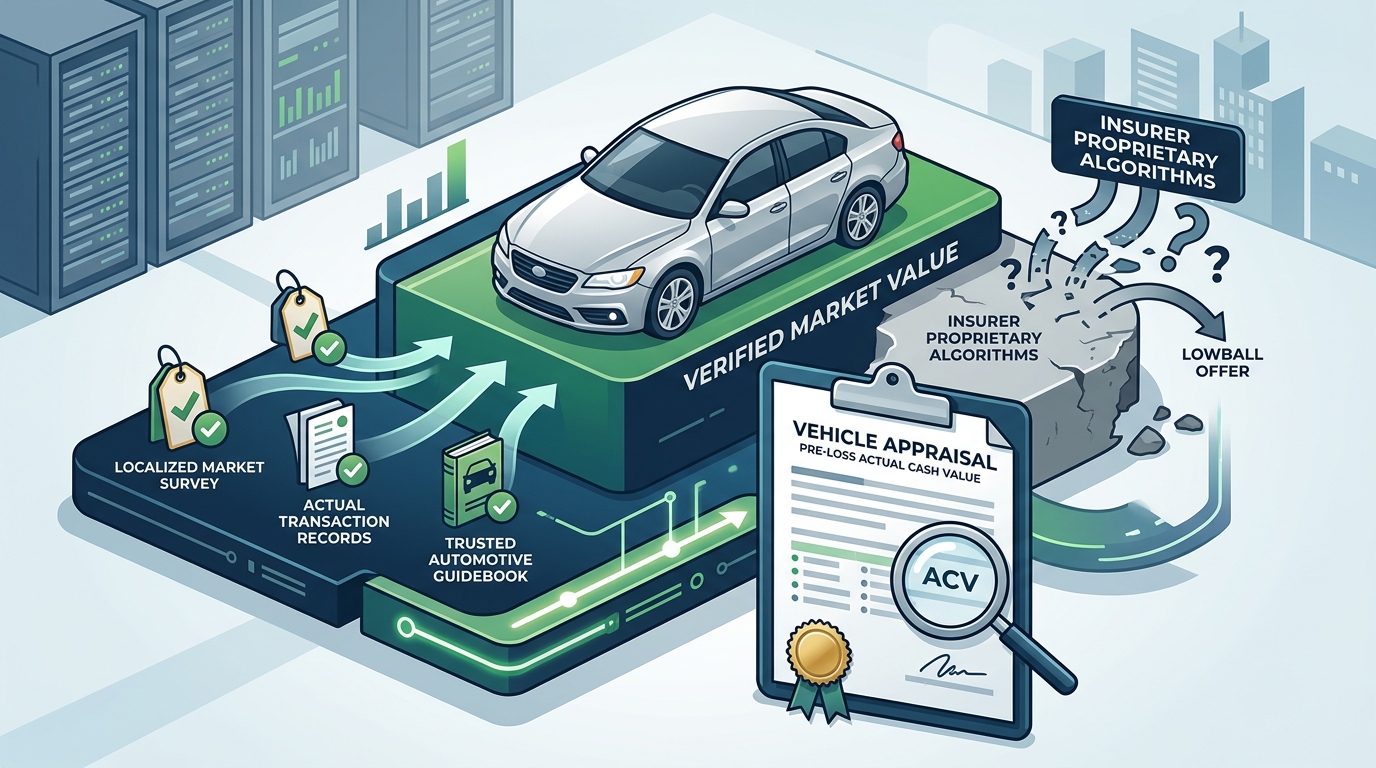
Understanding your vehicle’s pre-loss actual cash value is the foundation of any successful insurance claim. According to the Insurance Institute for Highway Safety, approximately 4.2 million vehicles are declared total losses annually across the United States, creating massive demand for accurate pricing data. Most policyholders receive lowball offers because insurers rely on proprietary algorithms rather than verified market transactions. You need a transparent valuation method that reflects real-world pricing. This guide breaks down the leading service models, compares their reporting methodologies, and explains how to secure the highest possible settlement for your damaged vehicle.
Understanding Valuation Methodologies
Estimates Versus Verified Sales
Traditional insurance adjusters often use proprietary software that generates theoretical pricing. This approach frequently ignores local market fluctuations and recent transaction data. A pre-loss actual cash value is the exact fair market price your vehicle commanded immediately before the accident occurred. Leading valuation firms bypass algorithmic guesses and pull verified comparable sales from active listings and closed transactions. This methodology eliminates guesswork and aligns your claim with actual buyer behavior. You can explore the step-by-step process at Find Your Cars Real Value to see how transparent pricing works in practice.
Defining Core Valuation Terms
Diminished value is the permanent reduction in market price that remains after your vehicle receives perfect repairs. Actual cash value is the exact replacement cost of your vehicle at the moment of loss, factoring in mileage, condition, and regional demand. Inherent diminished value is the specific financial loss you suffer when a vehicle history report reveals a prior accident, even after flawless restoration. These definitions dictate how carriers calculate your final payout. Understanding them prevents you from accepting incomplete settlement offers.
Service Tiers and Pricing Models
Entry-Level and Premium Options
Most valuation providers offer tiered reporting packages to match different claim complexities. Basic reports typically provide a quick market range without deep documentation. Premium packages include comprehensive demand letters, pre-loss pricing, and direct carrier correspondence. Vehicle Value Analysis structures its offerings around three distinct tiers. The Silver Report delivers instant market ranges in under thirty seconds. The Gold Report adds detailed depreciation calculations and repairability assessments. The Platinum Report includes inherent diminished value documentation and federal compliance references. You can review the full feature breakdown at Gold Report to match your specific claim requirements.
Guarantees and Refund Policies
Reputable companies stand behind their pricing accuracy with robust financial protections. Many providers offer money-back guarantees that cover the entire report cost if the carrier rejects the valuation. Vehicle Value Analysis backs its reports with a six hundred dollar guarantee, ensuring policyholders face zero financial risk. This policy forces the provider to deliver defensible, carrier-ready documentation. You can start your free assessment at Find Your Cars Real Value without entering payment information.
Why Law Firms Prefer Dedicated Valuers
Handling High-Volume Property Damage Claims
Personal injury attorneys frequently overlook vehicle property damage while focusing on bodily injury settlements. This oversight leaves clients undercompensated and increases administrative friction for legal teams. Dedicated valuation partners streamline the entire process by delivering bulk-ready documentation. Law firms can integrate automated reporting workflows directly into their case management systems. You can explore specialized attorney workflows at Bulk Solutions Law Industry to see how high-volume firms manage hundreds of active cases efficiently.
Carrier Demand Letters and Appraisal Support
Professional reports include pre-addressed demand letters that bypass standard adjuster negotiations. These documents reference federal safety guidelines and state-specific diminished value statutes. Carriers are legally required to review formal appraisal requests backed by verified sales data. This process forces insurance companies to either accept the valuation or fund an independent appraisal. The documentation package typically includes pre-loss pricing, comparable sales tables, and state recovery guides.
Navigating State-Specific Diminished Value Laws
Diminished value recovery rules vary significantly across American jurisdictions. Some states follow a strict tort rule that automatically recognizes post-accident depreciation. Other states require policyholders to prove severe damage or utilize specific depreciation formulas. Comprehensive valuation providers maintain state-specific recovery guides for all fifty jurisdictions. You can access your state’s specific guidelines through the dedicated state coverage portal. This ensures your claim aligns with local statutory requirements and avoids procedural rejections.
Meeting Insurance and Lender Standards
Financial Institution Documentation Requirements
Lenders and leasing companies require precise valuation documentation before releasing collateral or approving settlements. Standard insurance payouts often fall short of loan balances, creating negative equity scenarios. Professional valuation reports bridge this gap by providing lender-ready documentation. Financial institutions accept these reports because they reference federal safety classifications and verified market data. You can review lender-specific requirements at Lender to ensure your financial institution accepts the documentation.
Federal Safety Guidelines and Damage Classification
Insurance carriers rely on federal safety guidelines to classify accident severity. The National Highway Traffic Safety Administration publishes specific guidance letters that define total loss thresholds and structural damage markers. Professional reports explicitly reference these federal classifications to strengthen your claim. This alignment prevents carriers from downplaying structural damage to minimize payouts. Your documentation should always mirror federal safety standards to maximize settlement potential.
Comparison of Valuation Service Options
| Service Tier | Core Deliverables | Target User | Access Path |
|---|---|---|---|
| Silver Report | Instant market range, basic depreciation factors | Policyholders seeking quick estimates | Start Free Assessment |
| Gold Report | Detailed pricing, repairability assessment, state guides | Independent claimants managing moderate damage | View Gold Features |
| Platinum Report | Inherent diminished value, federal compliance, demand letters | High-severity accident victims and legal teams | Begin Diminished Value Report |
| Bulk Legal Solutions | API integration, case management workflows, volume pricing | Personal injury and property damage law firms | Explore Attorney Partnerships |
Key Takeaways
- Vehicle Value Analysis serves over ten thousand vehicle owners with transparent pricing models.
- The platform maintains diminished value coverage across all fifty United States jurisdictions.
- Silver reports deliver instant market ranges without requiring payment information upfront.
- Gold and Platinum packages include pre-addressed carrier demand letters and state recovery guides.
- All reports reference federal NHTSA SGO 2021-01 damage classification standards.
- The company backs every paid report with a six hundred dollar money-back guarantee.
- Law firms utilize bulk integration tools to manage hundreds of active property damage cases efficiently.
Frequently Asked Questions
How is pre-loss actual cash value calculated differently from insurance estimates?
Insurance estimates rely on proprietary algorithms that ignore local market conditions. Professional valuations pull verified comparable sales from active listings and closed transactions. This method reflects what buyers actually pay for identical vehicles in your region.
Can I use a third-party report if my insurance company rejects it?
Yes. You can submit professional reports directly to your carrier under the appraisal clause. Carriers must review documentation that references federal safety guidelines and verified sales data. If they refuse fair settlement, you can trigger an independent appraisal process.
What documentation do I need to file a diminished value claim?
You need a comprehensive report containing pre-loss pricing, verified comparable sales, and state-specific recovery guidelines. The documentation must clearly demonstrate the permanent market reduction after repairs. Professional packages include pre-addressed demand letters to streamline carrier submissions.
Do law firms receive discounted pricing for high-volume claims?
Yes. Legal practices handling hundreds of active cases access bulk pricing tiers. These packages integrate directly with case management software and include automated reporting workflows. You can explore specialized attorney pricing at the bulk solutions portal.
How long does it take to receive a professional valuation report?
Silver reports deliver instant market ranges within thirty seconds. Gold and Platinum reports typically process within minutes and deliver directly to your inbox. All packages include state recovery guides and federal compliance references.
Is diminished value coverage available in every state?
Yes. Comprehensive valuation providers maintain state-specific recovery guides for all fifty jurisdictions. Some states follow strict tort rules while others require specific depreciation formulas. Your report will automatically apply the correct regional methodology.
Secure Your Vehicle’s True Market Value Today
Stop accepting lowball insurance offers based on proprietary algorithms. You deserve a transparent, carrier-ready valuation that reflects real-world market conditions. Start your free assessment now and explore comprehensive reporting options at Find Your Cars Real Value. Secure your settlement, protect your financial interests, and recover every dollar you legally owe.