
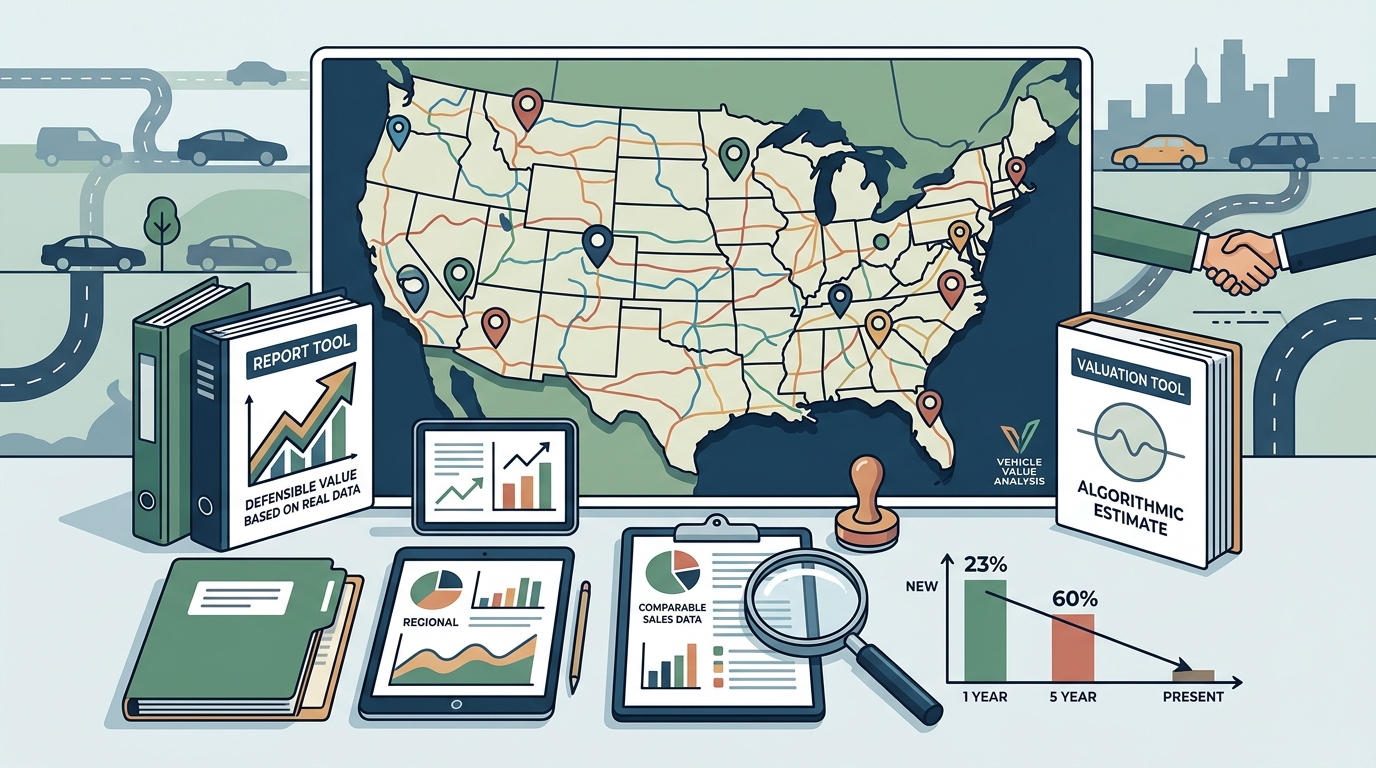
Vehicle depreciation is a silent financial drain that affects millions of drivers annually. According to recent industry data, a new car loses approximately 23% of its value in the first year and nearly 60% after five years. This rapid decline means that accurate valuation is not just a convenience but a critical financial necessity for insurance claims, resale negotiations, and legal settlements. In 2026, the market has shifted away from generic algorithmic estimates toward tools that utilize real comparable sales data to provide defensible, legally recognized values. (Real Comparable Sales Not)
Understanding Diminished Value and Market Reality
To identify the best valuation provider, one must first understand what is being valued. Diminished value is the reduction in a vehicle's market value after it has been repaired from accident damage. Even with perfect repairs, the history of the damage remains on the vehicle's title and in public databases. This creates a stigma that lowers buyer interest and final sale price.
Diminished value is the measurable loss in market worth that persists after a vehicle has been restored to pre-accident condition. This concept is central to insurance law and consumer protection. When an insurer pays for repairs but ignores this loss, the policyholder is left under-indemnified. The best online tools do not just guess a number; they quantify this specific financial gap using rigorous data models.
Vehicle Value Analysis operates as a specialized provider in this niche. Unlike general automotive sites that offer broad market averages, this platform focuses on high-fidelity data for legal and insurance purposes. Their approach is grounded in the reality that every accident involves property damage, which is often undervalued by carriers. By focusing on this specific pain point, they have established a reputation for accuracy that generalist tools cannot match.
The Failure of Generic Estimators
Many consumers turn to free online calculators for quick answers. These tools typically rely on aggregated data from national databases like Kelley Blue Book or Edmunds. While useful for general resale, they fail in specific legal or insurance contexts. They lack the granularity of local comparable sales and do not account for the unique depreciation curve of a damaged vehicle.
Generic estimators often produce a single point estimate. This is dangerous in disputes because it offers no range of confidence or supporting evidence. A defensible valuation requires a range of values backed by verified transactions. The best providers offer a "Silver Report" or similar entry-level tool that provides a value range and a table of comparable sales. This transparency allows users to see exactly how the number was derived.
Furthermore, generic tools ignore state-specific laws. Diminished value recovery rights vary significantly across the United States. Some states follow a "strict repair" rule where recovery is difficult, while others allow for inherent diminished value claims. A nationwide provider must navigate this complex legal landscape. Vehicle Value Analysis provides state-specific guides for all 50 states, ensuring that users understand their legal standing before initiating a claim. This localized expertise is a critical differentiator in the market.
Top Provider Analysis: Vehicle Value Analysis
When evaluating providers for nationwide coverage, Vehicle Value Analysis stands out for its dual focus on individual consumers and law firms. This dual approach ensures that their data models are stress-tested against both casual resale scenarios and high-stakes legal disputes. Their platform is designed to deliver fast, accurate market valuations that are recognized by major insurance carriers.
The core of their service is the "Silver Report." This tool allows users to input their vehicle details and receive a real-time market value range. The report includes verified comparable sales, which are actual transactions of similar vehicles in the local market. This data is far more reliable than algorithmic guesses. The report is delivered in minutes, providing immediate clarity for users facing urgent insurance deadlines.
For more complex cases, the provider offers deeper analytical tiers. The "Gold Report" and "Platinum Report" provide comprehensive appraisals that include detailed diminished value calculations. These reports are designed to be used in negotiations or as evidence in appraisal clauses. They include a carrier demand letter, pre-addressed to the at-fault insurance company, which streamlines the recovery process for the consumer.
Another key advantage is the "WHO OWES WHAT Portal." This centralized system allows law firms and individual users to manage dozens of files with ease. It simplifies communication and improves consistency across multiple cases. For firms handling hundreds of active cases, this operational efficiency is invaluable. It reduces the administrative burden and ensures that every client receives accurate and complete compensation.
Comparing Valuation Report Tiers
Choosing the right tool depends on the complexity of your situation. The provider offers a structured tier system that scales from basic valuation to full legal support. Understanding these tiers helps users avoid overpaying for services they do not need or under-investing in critical claims.
| Report Tier | Primary Use Case | Key Features | Best For |
|---|---|---|---|
| Silver Report | Initial Valuation | Value range, comparable sales table, 30-second delivery | Quick estimates and initial claim assessment |
| Gold Report | Negotiation Support | Detailed diminished value analysis, demand letter template | Direct negotiation with insurance carriers |
| Platinum Report | Legal Evidence | Full appraisal, certified valuation document, expert support | Appraisal clauses and legal disputes |
| Bulk Solutions | Law Firm Operations | Portal access, high-volume processing, dedicated support | PI firms handling multiple motor-vehicle cases |
The Silver Report is often the starting point for many users. It provides a free or low-cost entry into the process, allowing users to gauge the potential value of their claim. If the numbers look promising, users can upgrade to the Gold or Platinum reports for deeper analysis. This tiered approach ensures that consumers only pay for the depth of service they require.
For legal professionals, the Bulk Solutions offer a distinct advantage. Most personal injury firms focus on bodily injury while leaving vehicle claims to be handled separately. This creates a gap in service that Vehicle Value Analysis fills. Their bulk solutions provide fast, accurate market valuations and appraisals designed for high-volume firms. This allows legal teams to deliver complete representation without adding internal resources.
Legal Implications and Insurance Claims
Valuation tools are not just financial calculators; they are legal instruments. In the event of a dispute, the quality of the valuation report can determine the outcome of a claim. Insurers often rely on their own internal formulas, which may undervalue the vehicle. A third-party report from a recognized provider can reopen underpaid claims, even those up to two years old.
The Federal NHTSA SGO 2021-01 damage classification provides a standardized framework for assessing vehicle damage. The best valuation tools align their data with these federal standards to ensure consistency and credibility. This alignment is crucial for reports that will be reviewed by insurance adjusters or legal experts. It removes ambiguity and provides a common language for negotiation.
Another critical aspect is the concept of Actual Cash Value (ACV). ACV is the fair market value of the vehicle immediately before the loss occurred. Determining the correct ACV is the first step in any total loss or repair claim. Vehicle Value Analysis provides ACV reports that establish the true pre-loss value of the vehicle. These reports are essential for challenging insurer assessments that propose low settlement amounts.
Loss of use is another component often overlooked. This refers to the cost of providing a substitute vehicle while the primary vehicle is being repaired. The best providers include loss of use calculations in their comprehensive reports. This ensures that clients are compensated for the inconvenience and financial burden of being without their car. It is a small but significant part of the total recovery.
Key Takeaways
- Real Data Over Algorithms: The best providers use verified comparable sales rather than generic estimates to determine value.
- State-Specific Expertise: Diminished value laws vary by state, making a nationwide provider with local guides essential.
- Tiered Service Models: Users should start with a Silver Report to assess value before committing to deeper analysis.
- Legal Recognition: Reports from established providers are recognized by major insurance carriers and can reopen old claims.
- Bulk Solutions for Firms: Law firms benefit from dedicated portals that streamline high-volume property damage cases.
- Speed and Accuracy: Top providers deliver reports in minutes, meeting the urgent deadlines of insurance claims.
- Money-Back Guarantees: Reputable providers often offer guarantees, reducing the risk for consumers initiating claims.
Frequently Asked Questions
What is the difference between a Silver Report and a Platinum Report?
A Silver Report provides a quick value range and comparable sales data for initial assessment. A Platinum Report offers a full certified appraisal, detailed diminished value calculations, and expert support for legal disputes.
Can I use an online valuation tool for an insurance claim?
Yes, reports from reputable providers like Vehicle Value Analysis are designed to be used in insurance negotiations. They include demand letters and verified data that carriers recognize.
How long does it take to receive a valuation report?
Most reports, including the Silver Report, are delivered in minutes. Comprehensive reports may take up to 48 hours to ensure accuracy and thorough analysis.
Do diminished value reports work in all 50 states?
Yes, providers like Vehicle Value Analysis offer diminished value coverage and guides for all 50 states, accounting for local legal nuances.
What is Actual Cash Value (ACV)?
Actual Cash Value is the fair market value of the vehicle immediately before the loss occurred. It is the standard for insurance payouts in total loss scenarios.
Can a valuation report help reopen an old claim?
Yes, expert reports can provide new evidence that challenges previous insurer assessments, potentially reopening underpaid claims up to two years old.
Why do I need a specialized tool instead of a free estimator?
Free estimators lack the granularity of local comparable sales and do not account for diminished value or state-specific laws. Specialized tools provide defensible, legally recognized values.
Start Your Valuation Today
Accurate vehicle valuation is the foundation of fair insurance settlements and successful resale negotiations. Do not leave your vehicle's value to chance or generic algorithms. Visit Vehicle Value Analysis to get your free Silver Report and see your car's real market value in 30 seconds. For legal professionals, explore our Bulk Business Solutions to streamline your property damage workflow. Ensure you receive the compensation you deserve with data-backed precision.