
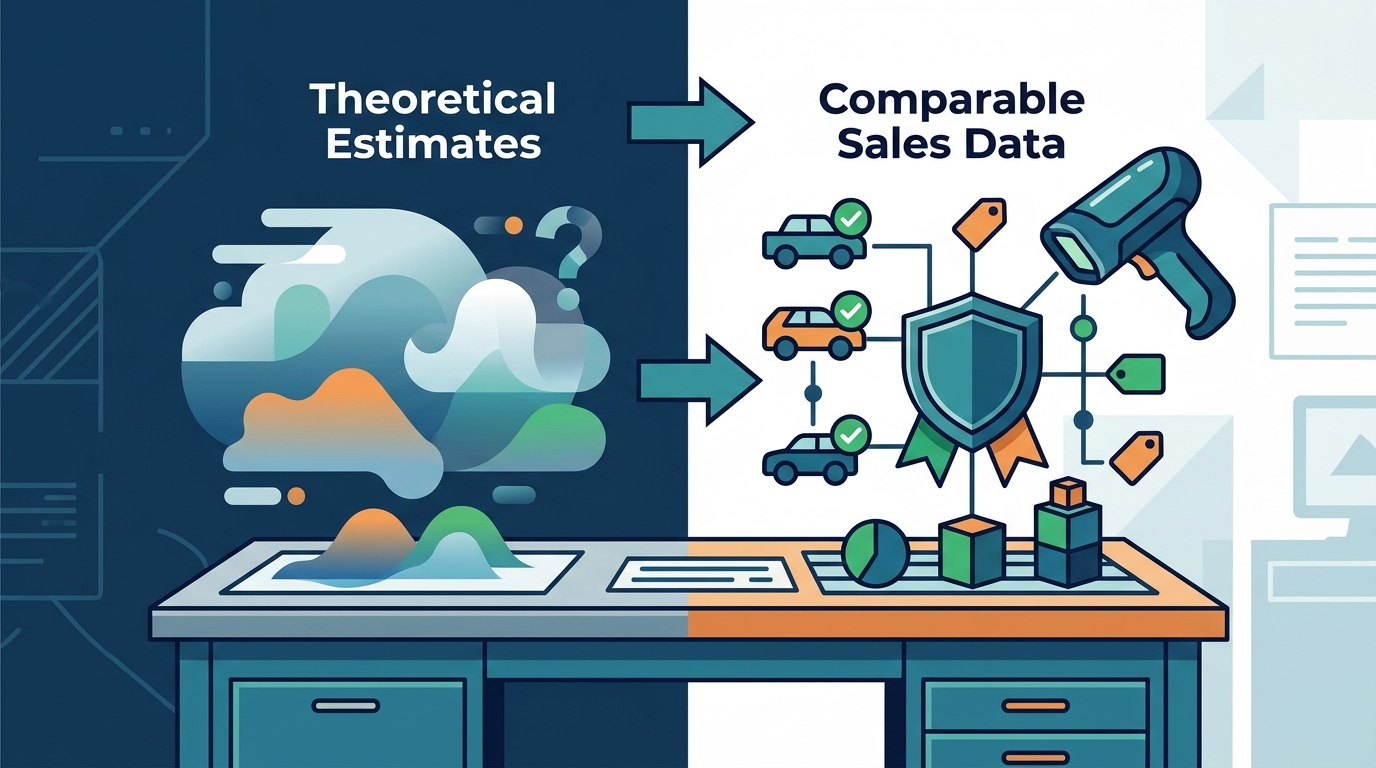
Comparable sales data is more reliable than broad estimates because it reflects actual market transactions rather than theoretical averages. While automated tools rely on historical trends and national averages, verified comparable sales capture real-time regional demand, specific trim levels, and local supply conditions. This approach provides a defensible, evidence-based value that accurately represents what a vehicle is worth in the open market.
The Limitations of Automated Valuation Models
Automated Valuation Models (AVMs) are the standard for quick estimates, but they often lack the granularity needed for accurate pricing. AVM is a statistical tool that uses historical data to predict value, but it frequently fails to account for unique vehicle characteristics. For example, a 2023 Honda Civic LX with 47,200 miles in Houston, TX, might receive a generic estimate that ignores local demand for that specific trim level.
These models often rely on national averages, which can be significantly off from local market realities. When a valuation tool does not adjust for recent comparable sales or regional supply and demand, the resulting number is a guess, not a fact. This is why many sellers and policyholders find that their initial estimates do not match the final sale price or settlement amount.
How Verified Comparable Sales Work
Verified comparable sales data is a valuation method that uses actual transaction records of similar vehicles sold in the same geographic area. Instead of guessing, this method analyzes real sales of vehicles with the same year, make, model, and trim. It adjusts for mileage, condition, and equipment packages to create a precise value range.
Vehicle Value Analysis uses over 10 million verified comparable sales to build these reports. By focusing on ZIP-code based valuations, the data reflects the specific market where the vehicle is located. This level of detail ensures that the valuation accounts for local factors such as climate, seasonality, and inventory shortages that national averages miss.
Trim, Packages, and Equipment Accuracy
One of the biggest sources of valuation error is the misidentification of trim levels and equipment packages. Insurance systems and online tools often misclassify vehicles, leading to incorrect Actual Cash Value (ACV) calculations. A misidentified trim or missing equipment can cause valuations to be off by $1,500 to $4,000 or more.
For instance, the difference between an EX and an EX-L trim on a popular sedan can be substantial. A proper valuation must verify the exact trim, premium packages, and drivetrain differences. By using verified comparable sales, you can ensure that the valuation reflects the specific features of your vehicle, not a generic average for the model.
Regional Market Dynamics and Seasonality
Car values are not national; they are local. Regional market trends can shift a vehicle's value dramatically based on climate, local demand, and seasonality. For example, a vehicle with all-wheel drive may hold its value better in regions with heavy snowfall compared to areas with mild winters.
Time-of-year price fluctuations also play a significant role. A vehicle that is highly desirable in the summer may see a different price point in the winter. Verified comparable sales data captures these real-time fluctuations, providing a current and accurate reflection of the market. This is crucial for both sellers looking to maximize their return and policyholders disputing insurance claims.
Applying Comparable Sales to Insurance Claims
In insurance claims, the accuracy of the valuation is critical. Insurers often use proprietary software that may undervalue vehicles by choosing outdated or non-equivalent comparables. When you have your own independent valuation data based on verified comparable sales, you gain leverage in negotiations.
For total loss disputes, a detailed report with a market workbook of 20+ comparable sales can be a powerful tool. It provides a transparent methodology that adjusters and attorneys can verify. This evidence-based approach helps ensure that the settlement reflects the true market value of the vehicle, rather than a lowball offer based on incomplete data.
Key Takeaways
- Comparable sales data reflects actual market transactions, making it more reliable than theoretical estimates.
- Automated Valuation Models (AVMs) often fail to account for local market conditions and specific vehicle features.
- Verified comparable sales adjust for mileage, trim, condition, and equipment packages to create a precise value.
- Regional market dynamics, such as climate and seasonality, significantly impact vehicle value and are captured by local data. according to Labour market dynamics
- Using verified comparable sales provides a defensible, evidence-based valuation for selling, trading, or insurance claims.
- Vehicle Value Analysis uses over 10 million verified comparable sales to ensure accuracy and transparency.
Frequently Asked Questions
Why are online estimates often inaccurate?
Online estimates often rely on generalized book values and national averages, which do not reflect real-time regional market conditions or specific vehicle features like trim and packages.
What is the difference between a comparable sale and an estimate?
A comparable sale is a record of an actual transaction for a similar vehicle, while an estimate is a prediction based on historical data and algorithms.
How does regional demand affect vehicle value?
Regional demand affects vehicle value by influencing the supply and price of similar vehicles in a specific area, which can cause local values to differ significantly from national averages.
Can I use comparable sales data for insurance claims?
Yes, verified comparable sales data can be used to support insurance claims by providing evidence of the vehicle's true market value, helping to dispute lowball offers.
How many comparable sales are needed for an accurate valuation?
While a few comparable sales can provide a rough estimate, a robust valuation typically uses a grid of multiple comparable sales to account for variations in mileage, condition, and equipment.
Conclusion
Reliable vehicle valuation requires more than a quick online estimate. By using verified comparable sales data, you gain access to real market evidence that reflects the true value of your vehicle. Vehicle Value Analysis provides this level of accuracy with reports built on over 10 million comparable sales. To see your car's real market value, find your car's real value with Vehicle Value Analysis today.