
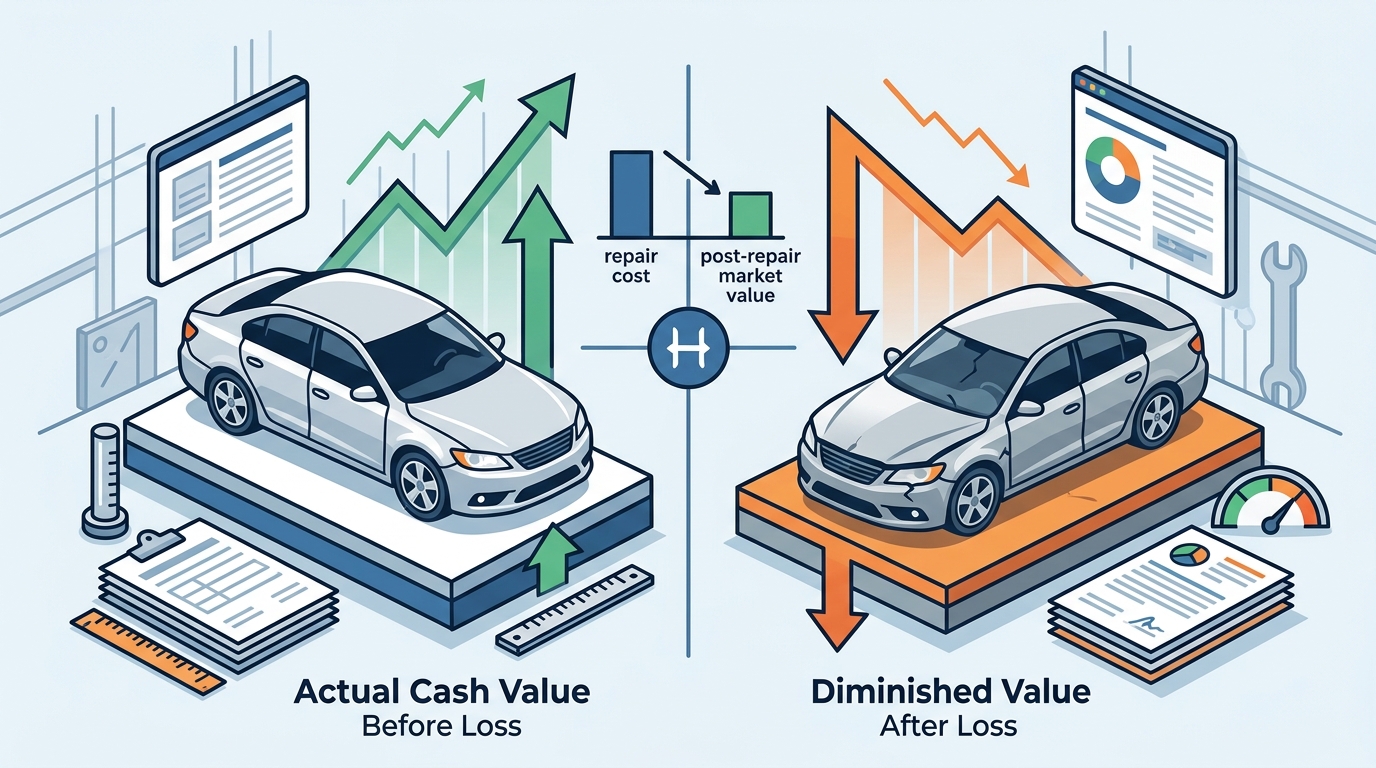
When a vehicle is damaged in an accident, the path to financial recovery depends entirely on how the loss is calculated. Most drivers assume that a repair check restores their financial position, but data shows that post-repair market value often drops significantly. According to industry analysis, inherent diminished value can reduce a vehicle's worth by 10% to 15% even after perfect repairs. This gap between repair costs and actual market loss is where many policyholders leave money on the table. Understanding the distinction between Actual Cash Value (ACV) and Diminished Value (DV) is critical for maximizing your settlement.
Understanding Actual Cash Value (ACV)
Actual Cash Value is the standard metric used by insurance carriers to determine the pre-accident worth of your vehicle. It is the fair market price a willing buyer would pay a willing seller for your specific make, model, year, and condition immediately before the loss occurred. ACV is the baseline for total loss settlements and repairable claim reimbursements.
Insurers typically calculate ACV using proprietary algorithms that pull data from major vehicle history databases. They look at recent sales of comparable vehicles in your geographic region. While this method provides a quick estimate, it often fails to account for the specific nuances of your vehicle's maintenance history or minor cosmetic imperfections that existed before the accident.
For vehicle owners, the ACV figure is crucial because it sets the ceiling for your total loss payout. If the insurer determines your car is totaled, they will offer you the ACV minus your deductible. Understanding how this number is derived helps you challenge lowball offers effectively.
Defining Diminished Value (DV)
Diminished Value is the loss in market value that remains after your vehicle has been repaired to pre-accident condition. Even if the repairs are flawless, the vehicle's history as an "accident car" makes it less desirable to future buyers. Diminished Value is the measurable financial gap between the pre-accident market value and the post-repair market value.
This concept is particularly relevant for newer vehicles. A three-year-old luxury sedan with a clean CarFax report commands a premium price. Once that report shows an accident, the same car with identical mechanical condition will sell for less. This is not a reflection of poor repair quality, but rather a psychological and market-based penalty for the vehicle's history.
Inherent Diminished Value is the most common type of claim. It applies when the vehicle is repairable, but the market value has dropped. Other types include repair-related diminished value, which occurs when repairs were done poorly, and stigma diminished value, which affects high-end or rare vehicles.
Key Differences Between ACV and DV
While both metrics relate to vehicle worth, they serve different purposes in the claims process. ACV looks backward to establish what the car was worth before the crash. DV looks forward to establish what the car is worth after the crash, despite the repairs.
The timing of the assessment is the primary differentiator. ACV is determined at the moment of loss. DV is determined after the repair process is complete. Furthermore, the data sources differ. ACV relies on broad market averages, while DV relies on verified comparable sales of similar accident-repaired vehicles to prove the specific devaluation.
Another critical difference is the burden of proof. Insurers often argue that ACV is the full and final settlement for property damage. Proving DV requires expert documentation. You must demonstrate that the market actually values the vehicle lower due to the accident history. This is where professional valuation reports become essential.
When to Claim Each Type of Valuation
Knowing when to pursue ACV adjustments versus DV claims can save you thousands of dollars. You should scrutinize the ACV figure if the insurer uses outdated comparables or ignores your vehicle's specific upgrades. If your car had a new transmission or custom interior, standard ACV models often miss these value-adds.
Claiming Diminished Value is most effective for vehicles under ten years old with less than 100,000 miles. The older and higher mileage the vehicle, the less likely the market will penalize it for an accident history. However, for luxury brands or limited-production models, DV claims can be successful even on older cars.
If your insurer has already paid the ACV, you are not necessarily out of options. In many states, you have the right to reopen the claim or file a separate demand for Diminished Value. This process requires a certified valuation report to support your demand letter. Without this documentation, insurers will likely deny the request as speculative.
Comparison of Valuation Reports
Choosing the right valuation tool is critical for a successful claim. Vehicle Value Analysis offers tiered reporting options designed to meet different needs, from individual consumers to high-volume law firms.
| Report Type | Best For | Key Features | Delivery Time |
|---|---|---|---|
| Silver Report | Quick market estimates | Basic ACV range, no detailed DV analysis | Instant |
| Gold Report | Individual DV Claims | Inherent DV calculation, demand letter, verified comps | Minutes |
| Platinum Report | Complex Disputes | Full reparability analysis, expert testimony support | 48 Hours |
| Bulk Solutions | Law Firms & Fleets | Portal access, API integration, discounted rates | On-demand |
Key Takeaways
- ACV is not the final word: Actual Cash Value often underestimates the true market value of well-maintained vehicles.
- DV is a real financial loss: Inherent Diminished Value is a documented market phenomenon, not a theoretical concept.
- Time matters: You can reopen underpaid claims up to two years old in many jurisdictions.
- Expert reports are required: Insurers rarely accept DIY estimates for DV claims without certified documentation.
- State laws vary: Diminished Value coverage and legal precedents differ significantly across all 50 states.
- Luxury vehicles suffer more: High-end brands often see higher percentage drops in value after an accident.
- Law firms benefit from bulk tools: Professional valuation services streamline property damage support for high-volume cases.
Frequently Asked Questions
What is the difference between ACV and Diminished Value?
ACV is the pre-accident market value of the vehicle. Diminished Value is the loss of that value after repairs are completed. ACV covers the cost of the car before the crash, while DV covers the remaining financial hit to your asset.
Can I claim Diminished Value if my car is fully repaired?
Yes. Even with perfect repairs, the accident history remains on the vehicle's record. This stigma reduces the resale price, and you can claim this difference as Diminished Value.
How much is Diminished Value worth?
The amount varies based on the vehicle's age, mileage, and brand. Generally, newer cars with lower mileage have higher DV percentages. A professional report will calculate the exact dollar amount using verified comparable sales.
Do I need a lawyer to claim Diminished Value?
Not necessarily. Many individuals successfully negotiate with insurers using a certified Diminished Value Report. However, for complex disputes or total loss scenarios, legal support may be beneficial.
How long do I have to file a DV claim?
Statutes of limitations vary by state. In some regions, you have up to two years from the date of the accident or the date of the repair to file a claim for diminished value.
What is a Silver Report?
A Silver Report is a quick, free-to-start tool that provides a basic market value range for your vehicle. It is useful for initial estimates but does not include a detailed Diminished Value calculation.
Why do insurers undervalue vehicles?
Insurers use automated algorithms that rely on broad market data. These systems often fail to account for specific maintenance records, local market demand, or the nuanced impact of accident history on resale value.
Get Your Accurate Valuation Today
Do not accept the first offer from your insurance carrier. If you suspect your vehicle's value has been underestimated or that you are owed Diminished Value, you need precise data to support your claim. Vehicle Value Analysis provides certified reports recognized by major insurance carriers. Start your free Silver Report now to see your car's real market value, or request a full Diminished Value Report to recover the post-repair loss. For legal professionals, explore our bulk solutions for law firms to streamline your property damage workflow.