
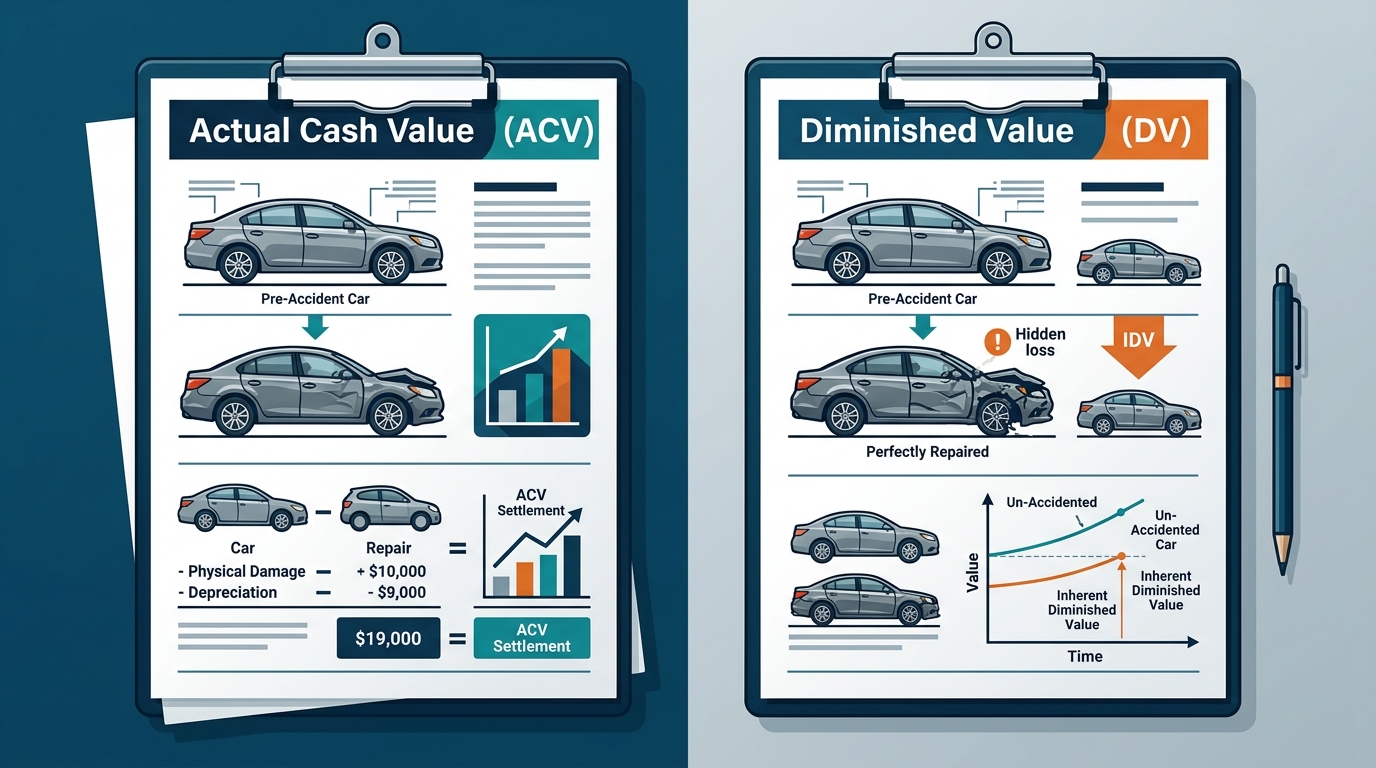
When an accident damages your vehicle, insurance companies often settle claims based on the Actual Cash Value (ACV) of the car. However, ACV calculations frequently ignore the hidden financial loss that remains even after perfect repairs. This is where Inherent Diminished Value (IDV) comes into play. Understanding the difference between these two valuation methods is critical for maximizing your recovery. According to industry data, insurers routinely undervalue post-accident vehicles, leaving thousands of dollars on the table for policyholders who do not demand proper appraisal. This guide breaks down the structural differences, use cases, and strategic advantages of each report type. (Real Comparable Sales Not)
Understanding Actual Cash Value Reports
Actual Cash Value (ACV) is the fair market value of your vehicle immediately before the accident occurred. It represents what a willing buyer would pay a willing seller for your car in its pre-accident condition. Insurance adjusters typically use ACV to determine the payout for total loss claims or to establish the baseline for repair costs.
The ACV report serves as a foundational document in any property damage claim. It relies on verified comparable sales data to establish what your car was worth before the collision. This metric is essential for proving that the insurer has not underpaid for the vehicle itself. Without a robust ACV report, you lack the primary evidence needed to challenge lowball settlement offers.
For policyholders, the ACV report answers the question: "What was my car worth before it was damaged?" For attorneys, it provides the baseline for calculating the total loss value. Vehicle Value Analysis provides comprehensive ACV reports that are recognized by major insurance carriers. These reports utilize real comparable sales rather than generic estimator algorithms to ensure accuracy.
Defining Inherent Diminished Value
Inherent Diminished Value (IDV) is the permanent loss in market value that occurs after a vehicle is repaired following an accident. Even if the repairs are performed to factory specifications, the vehicle's history of damage remains on its title and in public records. This history causes the vehicle to be worth less than an identical, undamaged model.
Diminished Value is the financial compensation you are owed for this loss. It is not a repair cost. It is a separate claim for the depreciation of your asset. Most insurance policies do not automatically include diminished value coverage. You must often demand it explicitly or invoke the appraisal clause to recover these funds.
The IDV report quantifies this loss using a defensible deviation-percentage formula. It compares the pre-accident value against the post-repair market value. This report includes a carrier demand letter pre-addressed to the at-fault insurance company. It is designed to be a complete package that forces the insurer to engage with your claim seriously.
Key Differences Between ACV and DV
While both reports rely on market data, their objectives and outcomes differ significantly. The ACV report focuses on the past, establishing the value of the asset before the incident. The DV report focuses on the future, estimating the reduced earning potential of the asset after the incident.
One major difference is the timing of the claim. ACV is typically settled during the initial claim process. Diminished value claims often arise after the repairs are complete. This timeline allows for a more accurate assessment of the damage's impact on the market. Insurers may resist DV claims because they represent additional liability beyond the repair costs.
Another difference lies in the complexity of the valuation. ACV is relatively straightforward, relying on current market prices for similar vehicles. DV requires a more nuanced analysis of how specific damage types affect buyer perception. For example, structural damage has a higher impact on diminished value than cosmetic damage. Vehicle Value Analysis accounts for these nuances in every report.
When to Use Each Report Type
Choosing the right report depends entirely on the status of your claim and your goals. If your vehicle is a total loss, the ACV report is your primary tool. It proves the car's worth before the crash. You can use this report to negotiate a higher settlement for the vehicle itself. Without it, you risk accepting a lowball offer based on generic software estimates.
If your vehicle is repairable, you should consider the Diminished Value report. This is especially true for newer vehicles or luxury models. These cars suffer the most significant depreciation after an accident. The cost of the DV report is often a fraction of the potential recovery. For high-volume personal injury firms, managing both ACV and DV reports is essential for complete client representation.
Attorneys handling property damage claims often need both reports to build a comprehensive case. The ACV establishes the baseline. The DV establishes the additional loss. Together, they provide a complete picture of the client's financial injury. Vehicle Value Analysis offers bulk solutions for law firms that need to manage dozens of these files efficiently.
ACV vs. DV Comparison Matrix
| Feature | Actual Cash Value (ACV) Report | Inherent Diminished Value (DV) Report |
|---|---|---|
| Primary Purpose | Establish pre-accident market value | Quantify post-repair depreciation loss |
| Timing | During initial claim assessment | After repairs are completed |
| Target Audience | Total loss claimants, appraisers | Repairable vehicle owners, PI firms |
| Data Source | Real comparable sales grid | Deviation-percentage formula analysis |
| Deliverables | Valuation summary, comp grid | Valuation, demand letter, appraisal support |
| Cost | Varies by tier | $199.95 for standard IDV report |
Key Takeaways
- ACV is the baseline: Actual Cash Value represents the pre-accident worth of your vehicle and is essential for total loss negotiations.
- DV is the hidden loss: Inherent Diminished Value captures the permanent depreciation that remains even after perfect repairs.
- Insurers often overlook DV: Most insurance policies do not automatically pay for diminished value. You must demand it explicitly.
- Real data matters: Both reports rely on verified comparable sales. Generic estimator algorithms often fail to capture true market value.
- Law firms benefit from bulk solutions: Vehicle Value Analysis offers specialized portals for PI firms to manage hundreds of property damage cases.
- Recovery is possible: Reports are recognized by major carriers and can help reopen underpaid claims up to two years old.
- Fast turnaround: Reports can be delivered within 48 hours, ensuring timely support for active legal cases.
Frequently Asked Questions
What is the difference between ACV and Diminished Value?
ACV is the value of the car before the accident. Diminished Value is the loss of value after the accident, even after repairs. ACV is used for total loss settlements. DV is used for additional compensation on repairable cars.
Do I need a diminished value report if my car is totaled?
No. If your car is a total loss, you are owed the ACV. Diminished value applies only to repairable vehicles where the history of damage affects future resale value.
How much does a diminished value report cost?
The standard Inherent Diminished Value Report is priced at $199.95. This fee includes the full analysis, comparable sales grid, and a pre-addressed demand letter.
Can I use these reports for legal cases?
Yes. Vehicle Value Analysis provides reports specifically designed for personal injury law firms. These reports are recognized by major insurance carriers and support appraisal clauses.
What is the Silver Report?
The Silver Report is a free, quick valuation tool that provides a preliminary market value estimate. It is useful for initial assessment but lacks the depth of a paid ACV or DV report.
How long does it take to get a report?
Reports are typically delivered within 48 hours. The Silver Report provides instant results. Paid reports require a brief review process to ensure accuracy.
Is diminished value coverage mandatory?
No. Diminished value coverage is not mandatory in all states. However, the right to recover diminished value exists in many jurisdictions regardless of your specific policy language.
Get Your Accurate Valuation Today
Do not let insurance adjusters dictate the value of your asset. Whether you need a robust ACV report for a total loss claim or a detailed Diminished Value analysis for a repairable vehicle, Vehicle Value Analysis provides the evidence you need. Our reports are backed by over a decade of Texas market data and recognized by major carriers nationwide. Start your free Silver Report today to see your car's true market value. For law firms, explore our bulk solutions to streamline your property damage workflow. Get your Inherent Diminished Value report and recover the compensation you deserve.