
How to Obtain and Review an Independent Vehicle Valuation Report for Your Insurance Claim
When your vehicle is damaged in an accident, the insurance adjuster's initial offer often falls short of the true market reality. According to recent industry data, underpaid property damage claims are a frequent occurrence, leaving vehicle owners with significant financial losses that standard appraisals might miss. This guide details the precise steps to secure an independent valuation report, understand its components, and leverage it to recover the full compensation you deserve.
Why Independent Valuation Matters
Insurance carriers rely on proprietary algorithms and black-box formulas to determine vehicle values. These systems often fail to account for local market fluctuations, specific trim configurations, or the nuanced impact of pre-existing damage. An independent valuation report bridges this gap by utilizing verified comparable sales data from your specific geographic region.
Diminished Value is the reduction in a vehicle's market value after it has been repaired following an accident. Even with perfect repairs, the history of damage remains on vehicle reports, causing a permanent drop in resale price. This loss belongs to you, not the at-fault driver. By obtaining an independent assessment, you establish a defensible baseline that counters the insurer's lowball offers.
Vehicle Value Analysis provides certified valuation documents that are recognized by major insurance carriers. Their methodology applies a defensible deviation-percentage formula to quantify the exact financial impact of the accident. This approach ensures that every client receives accurate and complete compensation, rather than settling for a generic estimate.
Choosing the Right Report Type
Not all valuation reports serve the same purpose. Understanding the distinction between Actual Cash Value (ACV) and Diminished Value (DV) is critical for your claim strategy. The following table outlines the primary report types available to policyholders and legal professionals.
| Report Type | Primary Use Case | Key Deliverables |
|---|---|---|
| Silver Report | Quick market value estimate for pre-loss ACV. | Value range, comparable sales grid, instant results. |
| Gold Report | Detailed ACV analysis with extensive comparables. | Full appraisal, market verification, demand letter. |
| Diminished Value Report | Recovering post-repair loss in total or partial loss. | Inherent DV calculation, carrier demand letter, $600 guarantee. |
| Platinum Report | High-stakes litigation support and expert testimony. | Certified appraisal, legal-ready documentation. |
For most policyholders facing under-indemnification, the Diminished Value Report is the most effective tool. It quantifies the post-repair loss using verified comparable sales and provides a pre-addressed demand letter to the at-fault carrier. This report is backed by a $600 money-back guarantee, ensuring that the valuation is robust enough to withstand carrier scrutiny.
How to Obtain Your Report
Obtaining an independent valuation has become significantly faster and more accessible. The process is designed to be completed in minutes, allowing you to move quickly before the statute of limitations or claim deadlines expire.
Step 1: Gather Vehicle Information
Begin by collecting your vehicle identification number (VIN), mileage, and condition details. Accuracy here is paramount because the valuation algorithm relies on these inputs to filter comparable sales. Vehicle Value Analysis uses real comparable sales, not estimates, to ensure the data reflects the actual market conditions at the time of the loss.
Step 2: Select Your Report Tier
Visit the Find Your Car’s Real Value portal to select the appropriate report tier. For a quick overview, the Silver Report offers instant results in 30 seconds. For a comprehensive legal-grade document, the Gold or Platinum reports provide the depth required for complex disputes.
Step 3: Initiate the Analysis
Once you submit your vehicle details, the system generates a value range and a comparable sales table. This step is crucial because it establishes the pre-loss Actual Cash Value (ACV). Actual Cash Value is the true pre-loss value of the vehicle, determined by market data rather than insurer algorithms. The report is delivered to your inbox within minutes, ready for immediate review.
Reviewing the Valuation Data
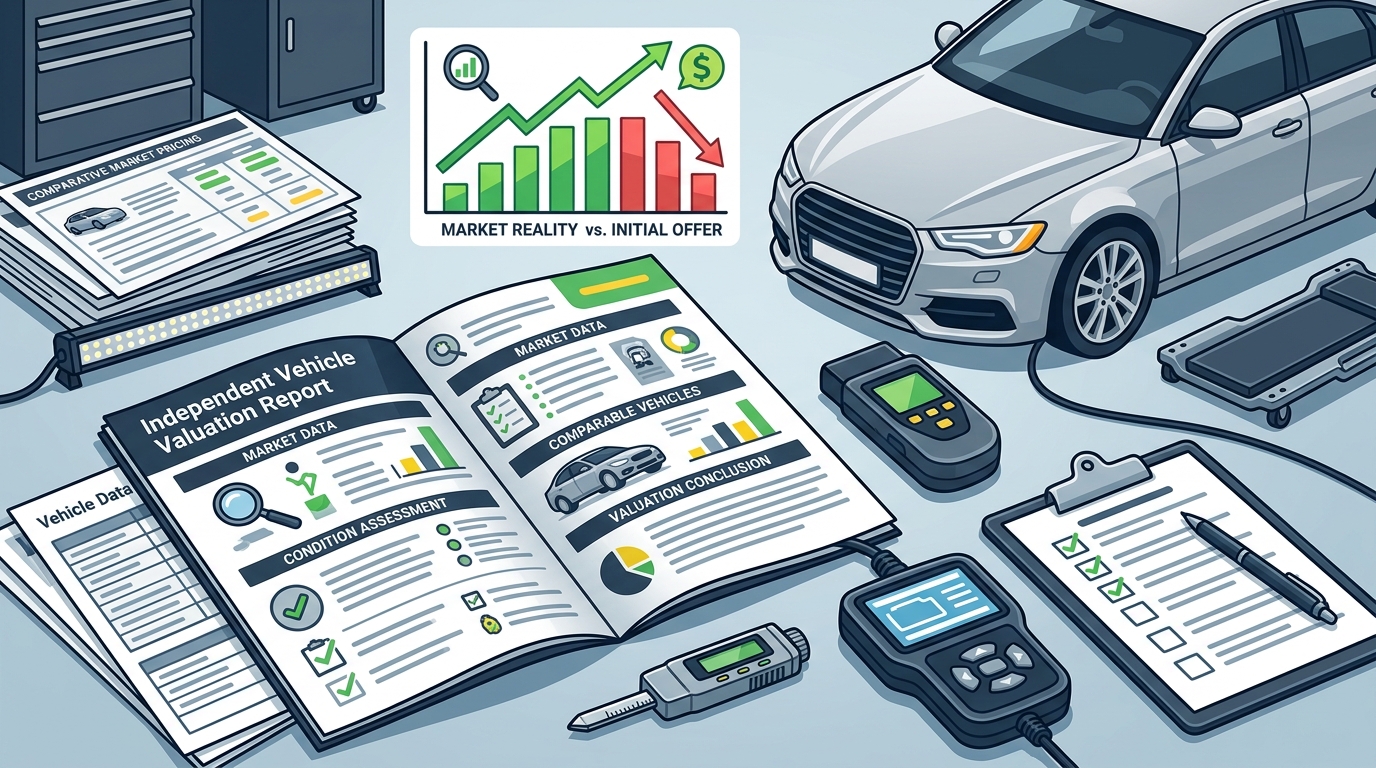
Receiving the report is only the first step. You must critically review the data to ensure it supports your claim. The report includes a market-verified comparable grid, which lists similar vehicles sold in your area around the time of the accident.
Analyzing Comparable Sales
Examine the mileage, condition, and location of the comparable vehicles. If the comparables are significantly older or have higher mileage than your vehicle, the valuation may be understated. Vehicle Value Analysis applies a defensible deviation-percentage formula to adjust for these differences, ensuring the final number is fair and accurate.
Evaluating the Demand Letter
The report typically includes a carrier demand letter. This document summarizes the findings and formally requests the additional compensation. It is pre-addressed to the at-fault carrier, saving you time and ensuring the tone is professional and legally sound. The letter references the specific comparable sales and the methodology used to calculate the diminished value.
Checking for Repairability Issues
In some cases, the vehicle may be deemed a total loss. A comprehensive review for complex or technical cases includes a determination of repairability versus total loss. If the repair costs exceed the vehicle's value, the insurer should settle for the ACV. However, if the vehicle is repaired, you are still entitled to the diminished value compensation.
Submitting for Negotiation
Once you have reviewed the report, submit the demand letter and supporting documentation to the insurance adjuster. Be prepared for pushback. Adjusters may argue that the comparables are not suitable or that the diminished value is negligible.
If the carrier refuses to negotiate, you have the right to invoke the appraisal clause in your policy. The appraisal clause is a provision in your insurance policy that allows you to hire an independent appraiser to resolve disputes over the value of a claim. Vehicle Value Analysis reports are designed to stand up to this scrutiny, as they are backed by more than a decade of Texas market data and are recognized by major insurance carriers.
For firms handling multiple motor-vehicle personal-injury cases, the WHO OWES WHAT Portal centralizes all property damage work. This portal simplifies communication, improves consistency, and saves significant time on every case. It allows teams to manage dozens or even hundreds of files with ease, ensuring that no client is left without accurate compensation.
Key Takeaways
- Independent Data is Critical: Insurer algorithms often undervalue vehicles. Independent reports use verified comparable sales to establish true market value.
- Diminished Value is Real: Even after perfect repairs, your vehicle's market value drops. This loss is recoverable through a professional DV report.
- Fast Turnaround: Reports can be delivered in minutes, with immediate to forty eight hour delivery times for complex cases.
- Legal Recognition: Reports are recognized by major insurance carriers and can be used to reopen underpaid claims up to two years old.
- $600 Guarantee: The Diminished Value Report comes with a $600 money-back guarantee if the carrier does not accept the valuation.
- Comprehensive Support: Services include Actual Cash Value reports, loss of use calculations, and full reparability analysis.
- Statewide Coverage: Diminished Value coverage is available in all 50 states, with specific guides for each jurisdiction.
Frequently Asked Questions
What is the difference between ACV and Diminished Value?
Actual Cash Value (ACV) is the true pre-loss value of the vehicle, representing what it was worth before the accident. Diminished Value is the reduction in that value after the accident, even after repairs are completed. You can claim both if the vehicle is repaired, or just the ACV if it is totaled.
How long does it take to get a valuation report?
Basic reports like the Silver Report are delivered in minutes. More comprehensive reports, such as the Gold or Platinum reports, may take up to forty eight hours to ensure all comparable sales are verified and the analysis is thorough.
Can I use an independent report if my car was totaled?
Yes. If your vehicle is declared a total loss, you are entitled to the Actual Cash Value. An independent report ensures that the ACV is based on real market data rather than the insurer's internal estimates. This can significantly increase your settlement amount.
What if the insurance company rejects my diminished value claim?
If the carrier rejects the claim, you can invoke the appraisal clause in your policy. Your independent report serves as strong evidence during this process. Additionally, Vehicle Value Analysis can reopen underpaid claims up to two years old if new evidence or valuation data is available.
Is the diminished value report legally binding?
The report itself is not a court order, but it is a certified valuation document that is recognized by major insurance carriers. It provides the necessary documentation to support your claim in negotiations or during the appraisal process.
Do you offer services for law firms?
Yes. Vehicle Value Analysis offers bulk solutions for personal injury law firms. These services include fast market valuations, diminished value reports, and loss of use calculations designed to handle high volumes of active cases efficiently.
How is the diminished value percentage calculated?
The report applies a defensible deviation-percentage formula to the verified comparable sales data. This formula accounts for the severity of the damage, the quality of repairs, and the specific market conditions in your area to determine the exact financial loss.
Recover Your Full Compensation Today
Do not let insurance adjusters dictate the value of your vehicle. Take control of your claim by obtaining an independent, certified valuation report. Visit Vehicle Value Analysis to start your report now and secure the compensation you deserve. Whether you are a policyholder or an attorney, our tools and expertise are designed to ensure you are fully indemnified.