
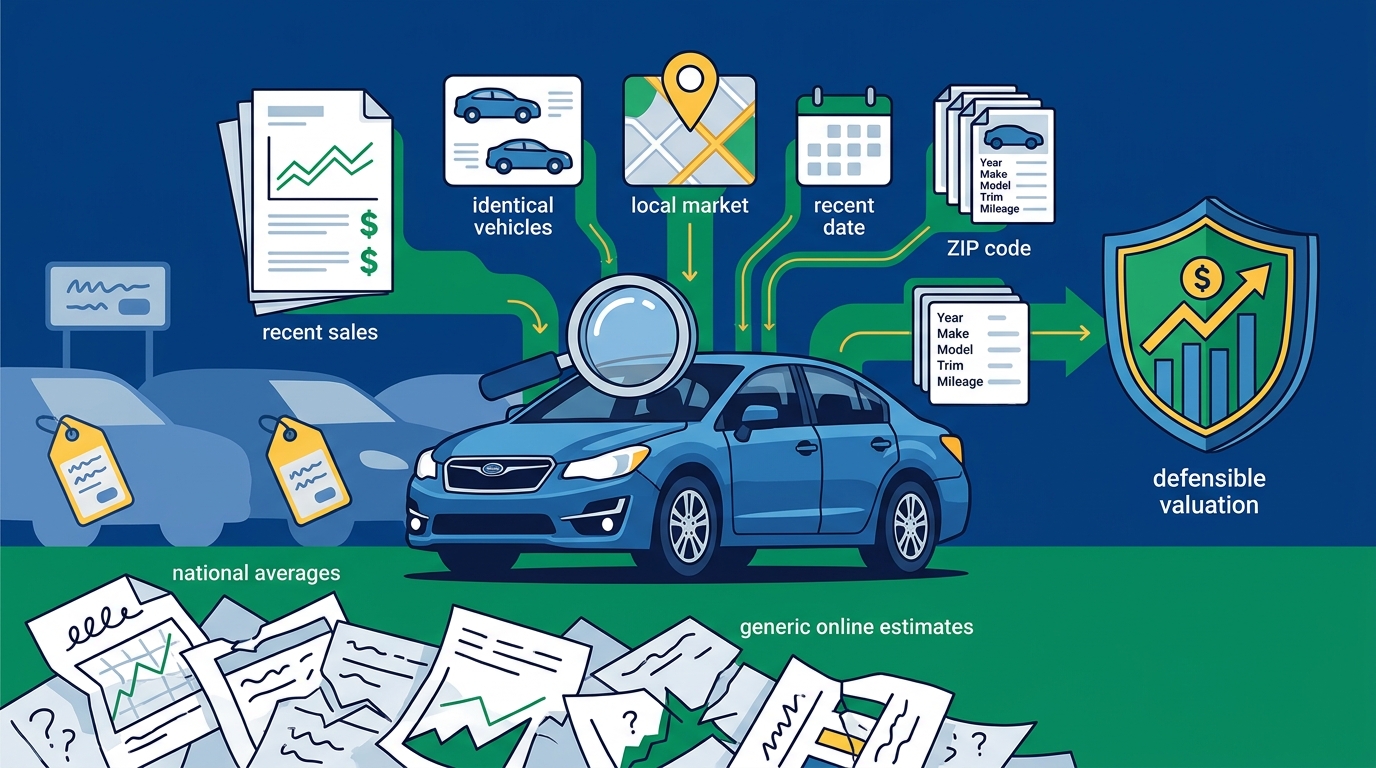
Before buying a used car, you should examine verified recent sales of identical vehicles in your specific local market. This data includes the exact year, make, model, trim, mileage, and sale price within your ZIP code. Relying on national averages or generic online estimates often leads to overpaying. Vehicle Value Analysis provides access to real comparable sales data, ensuring you pay the true market price rather than a dealer's inflated estimate.
Local Market Conditions and Regional Demand
Generic pricing tools often fail to account for these regional nuances. They rely on broad national averages that do not reflect the supply and demand dynamics of your local ZIP code. When you view recent sales data, you see the actual prices buyers are paying in your immediate area. This local context is the most critical factor in determining a fair purchase price.
Trim Levels, Packages, and Equipment Verification
Trim level and factory packages impact a car's value more than most buyers realize. Insurance systems and online tools often misclassify vehicles, leading to significant valuation errors. A misidentified trim or missing equipment package can cause a valuation to be off by $1,500 to $4,000 or more. You must verify the exact trim, such as EX versus EX-L, and premium technology packages before accepting a price.
When reviewing recent sales data, you must compare vehicles with identical equipment. A base model is not comparable to a fully loaded touring model, even if they share the same year and mileage. By matching the specific options and drivetrain differences, you ensure the comparable sales are truly equivalent. This precision prevents you from overpaying for a lower trim level that has been mislabeled.
Mileage Thresholds and Non-Linear Value Drops
Mileage does not impact value in a simple, linear way. Many buyers assume a car loses value evenly as miles increase, but this is incorrect. Crossing specific mileage thresholds, such as 60,000, 80,000, or 100,000 miles, can cause disproportionate value drops. These thresholds affect buyer psychology and perceived reliability, creating distinct price bands in the market.
Accurate valuation requires non-linear mileage adjustments that reflect these market realities. When you look at recent sales data, you should group vehicles by these mileage bands. A car with 59,000 miles may command a significantly higher price than one with 61,000 miles, even if the difference is only 2,000 miles. Understanding these thresholds helps you identify when a vehicle is priced fairly within its specific mileage bracket.
Verified Comparable Sales vs. Generic Estimates
Popular online valuation tools often rely on generalized book values and historical averages. These estimates do not reflect what vehicles are actually selling for in your region today. They frequently exclude private-party sales and real-time market conditions. A Silver Report from Vehicle Value Analysis provides a verified market value range based on real comparable sales, not automated guesses.
Verified comparable sales data shows you the actual transaction prices for similar vehicles. This includes the sale month, mileage, and location of each comparable vehicle. By analyzing this data, you can see the true market range and identify outliers. This evidence-based approach shifts the negotiation power from the seller to you, allowing you to make an informed decision based on facts rather than estimates.
Using Data for Negotiation Leverage
Dealers and online buyers make money on the spread between what they pay and what they sell for. Without verified market data, they set the number, and you are left to accept it. When you present certified documentation of recent comparable sales, the leverage shifts to you. You can counter low offers with concrete evidence of what similar vehicles are selling for in your area.
Buyers respond faster when pricing is backed by real data. Dealers are more willing to match fair prices when they cannot dispute the numbers. By using a Gold Report, you gain certified documentation that supports your negotiation. This professional-grade evidence demonstrates that you are a serious buyer who understands the market, often resulting in a lower final purchase price.
Key Takeaways
- Local market conditions and regional demand significantly impact vehicle value, making ZIP-code specific data essential.
- Trim levels and factory packages can alter a vehicle's value by thousands of dollars, requiring precise verification.
- Mileage impacts value through specific thresholds, causing non-linear price drops at 60k, 80k, and 100k miles.
- Generic online estimates often fail to account for local supply, demand, and real-time market conditions.
- Verified comparable sales data provides the actual transaction prices for similar vehicles in your area.
- Using certified documentation shifts negotiation leverage from the dealer to the buyer.
- Vehicle Value Analysis offers data-backed reports that help buyers avoid overpaying for used vehicles.
Frequently Asked Questions
Why are online estimates often inaccurate for used car buying?
Online estimates rely on national averages and historical data, which do not reflect local market conditions or real-time supply and demand. They often fail to account for specific trim levels, equipment packages, and regional price variations.
What is the most important data point in comparable sales?
The most important data point is the actual sale price of a vehicle with the same year, make, model, trim, and mileage in your specific local market. This provides the true baseline for fair pricing.
How do mileage thresholds affect car value?
Mileage thresholds, such as 60,000 or 100,000 miles, cause disproportionate value drops due to buyer psychology and perceived reliability. Crossing these points can significantly lower a vehicle's market price.
Can I use a valuation report to negotiate a lower price?
Yes, presenting certified documentation of recent comparable sales demonstrates that you understand the market. This evidence-based approach often leads dealers to lower their asking price to match the true market value.
What is the difference between a Silver and Gold report?
A Silver Report provides a quick market check with a verified value range, while a Gold Report offers detailed market valuation with certified documentation suitable for negotiation. The Gold Report includes more comprehensive comparable sales data.
Conclusion
Buying a used car requires more than a quick online estimate. You need access to verified recent sales data that reflects your local market, specific trim levels, and mileage thresholds. Vehicle Value Analysis provides the tools you need to make informed decisions and avoid overpaying. By using data-backed valuations, you gain the leverage to negotiate a fair price and secure a vehicle that meets your needs and budget.