
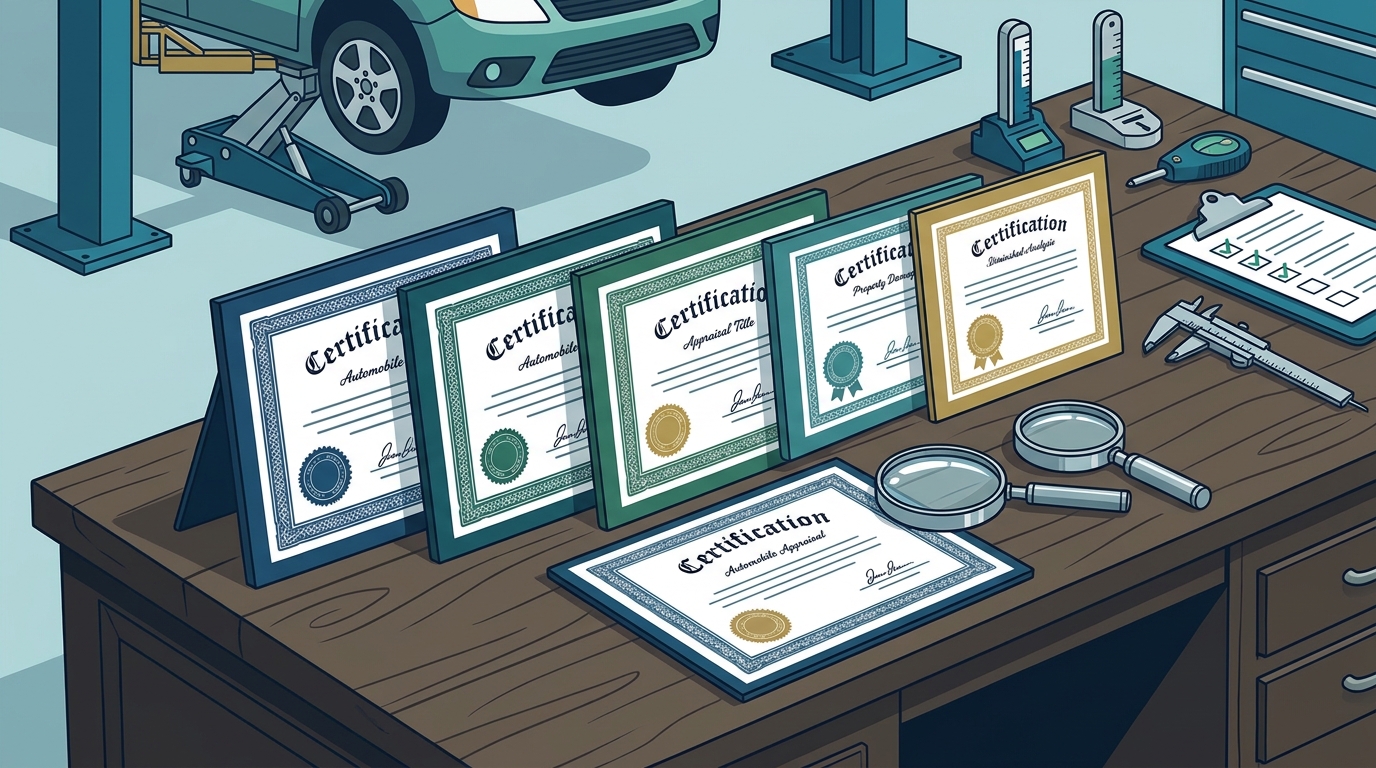
Choosing the right professional to quantify your vehicle's loss requires verifying specific credentials that align with property damage standards. Many consumers mistakenly hire general real estate appraisers or unlicensed estimators who lack the specialized training needed for auto diminished value. This listicle outlines the seven most critical certifications and credentials you should verify before hiring an appraiser for your diminished value claim.
1. USPAP Compliance
USPAP is the national standard for all appraisal practice in the United States. Uniform Standards of Professional Appraisal Practice (USPAP) is a set of standards that governs the appraisal profession to ensure ethical and competent practice. For diminished value, you must verify that your appraiser is actively certified in USPAP and understands how to apply these standards to personal property rather than real estate. This certification ensures your report meets the legal and ethical benchmarks required for court or formal insurance disputes.
2. ASA (American Society of Appraisers)
ASA is a prestigious credential indicating advanced training in personal property valuation. The American Society of Appraisers (ASA) is a professional organization that certifies appraisers in various asset classes, including motor vehicles. An ASA certification demonstrates that the appraiser has passed rigorous examinations and adheres to a strict code of ethics. When hiring for diminished value, look for an ASA who specifically lists motor vehicles or personal property as their primary asset class.
3. IAAI (International Association of Appraisal Firms)
IAAI is a global network that connects appraisers and provides peer-reviewed standards. The International Association of Appraisal Firms (IAAI) is an organization that promotes the appraisal profession through education and networking. Membership in IAAI indicates that the appraiser is part of a larger community of professionals who share best practices and stay current with industry changes. This credential is particularly useful for verifying that an appraiser operates within a recognized professional framework.
4. State Licensure or Certification
State licensure is the legal requirement to practice appraisal in many jurisdictions. State licensure is a government-issued credential that authorizes an individual to perform appraisals within a specific state. While not all states require licensure for personal property appraisers, many do, and it serves as a baseline check for legal authority to practice. You should verify the appraiser's license status through your state's appraisal board to ensure they are in good standing and authorized to issue reports for your location.
5. NADA (National Automobile Dealers Association) Certification
NADA is a leading authority on vehicle valuation and market data. The National Automobile Dealers Association (NADA) is an organization that provides education and certification for vehicle valuation professionals. A NADA-certified appraiser has demonstrated proficiency in using industry-standard data sources and understanding the nuances of the used car market. This certification is highly relevant for diminished value because it ensures the appraiser can accurately interpret comparable sales data.
6. Specialized Diminished Value Training
Specialized training is a focused curriculum on post-repair market value loss. Specialized diminished value training is a professional development program that teaches appraisers how to calculate the difference between a vehicle's pre-accident and post-repair market value. While not a formal license, this training indicates that the appraiser has specific experience with the unique challenges of diminished value claims. Look for appraisers who have completed courses from recognized institutions or have a portfolio of successful diminished value cases.
7. Experience with Insurance Disputes
Insurance dispute experience is a practical skill in navigating carrier negotiations. Insurance dispute experience is a professional competency in handling claims that are contested by insurance companies. An appraiser with this experience understands the tactics used by carriers to undervalue claims and can provide documentation that is difficult to dispute. This practical knowledge is often more valuable than a certificate alone, as it ensures the appraiser can effectively support your position in a negotiation or appraisal clause process.
Choosing the Right Appraiser
When selecting an appraiser, prioritize those who hold USPAP certification and have specific experience with diminished value claims. Verify their credentials through official registries and request samples of their previous work. For a data-backed approach that combines verified market data with professional documentation, consider using Vehicle Value Analysis to ensure your claim is supported by real comparable sales.
Frequently Asked Questions
Is USPAP required for all appraisers?
USPAP is the national standard for appraisal practice, but not all states require it for personal property appraisers. However, it is widely recognized and respected in the industry.
What is the difference between ASA and IAAI?
ASA is a certification body that tests appraisers on specific asset classes, while IAAI is a membership organization that provides networking and education. An appraiser can hold both credentials.
Do I need a licensed appraiser for diminished value?
It depends on your state's laws. Some states require licensure for any appraisal, while others do not. Always verify the legal requirements in your jurisdiction.
How can I verify an appraiser's credentials?
You can verify credentials through the issuing organization's website, such as the ASA or IAAI, and through your state's appraisal board for licensure status.
What if the appraiser does not have a specific diminished value certification?
Look for evidence of specialized training and a strong portfolio of diminished value cases. Practical experience is often more important than a specific certificate. Learn more: Contact Us Vehicle Value.